On this page
Yes, with an important limitation
Yes, weather reports can help verify a date of loss, but only as supporting evidence. They can show that hail, damaging wind, or another weather event was reported near a property at a particular time. They do not, by themselves, prove that the event damaged that specific property.
In property insurance records, the date of loss is the date the loss occurred. It is distinct from the date the claim was reported. The Texas Department of Insurance, for example, requires those dates as separate fields in residential-property claim data.
What a weather report can establish
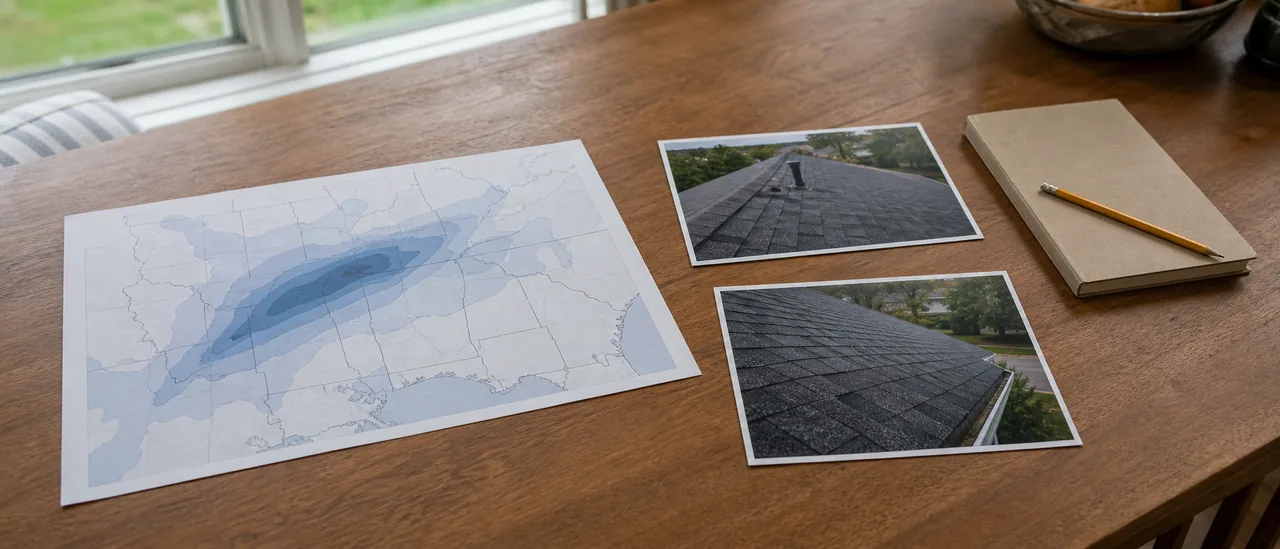
The strongest match combines the reported hazard, time, and location. A National Weather Service Local Storm Report may include the event type, occurrence time, location, latitude and longitude, report source, damage, and remarks. These reports are preliminary; finalized events appear later in NOAA’s monthly Storm Data publication.
NOAA’s Storm Events Database provides another historical record. It contains the reports used for Storm Data and can be searched by details such as state, county, dates, and event type. Because final reports may take 90 to 120 days to appear, a recent event may have only preliminary records available.
A storm match is not a property match
A report close in time and distance can corroborate a proposed date. It cannot establish that hail struck one address, that visible wear came from that storm, or that every nearby property experienced the same conditions.
Where the evidence has limits
Radar-derived hail information is useful for narrowing a time window and geographic area, but it describes estimated or probable conditions. NOAA warns that much of its Severe Weather Data Inventory is automatically derived from radar and does not represent a confirmed occurrence. It also says missing data should not be read as proof that severe weather did not occur.
Distance matters as well. A report elsewhere in the same county is less specific than a measured observation near the address. Storms can vary over short distances, and report times may be estimated. For that reason, evaluate the record’s coordinates, time zone, event type, measurement method, and whether the entry is preliminary or final.
The practical bottom line
A credible date-of-loss assessment usually aligns weather evidence with property-specific information, such as dated photographs, inspection notes, repair records, maintenance history, and observations about the condition and apparent age of damage. The sources should agree on both timing and cause rather than merely showing that a storm happened somewhere nearby.
Weather reports are therefore valuable corroboration—not a stand-alone verdict. The applicable policy and state rules determine how the date is used, while the physical evidence determines whether the reported event plausibly connects to the condition at the property.