On this page
Yes, a home inspector can miss rotted support beams
Yes, especially when decay is concealed, the area is inaccessible, or visible clues do not suggest damage. A standard home inspection covers structural components, but it is a visual examination rather than a destructive investigation or engineering analysis.
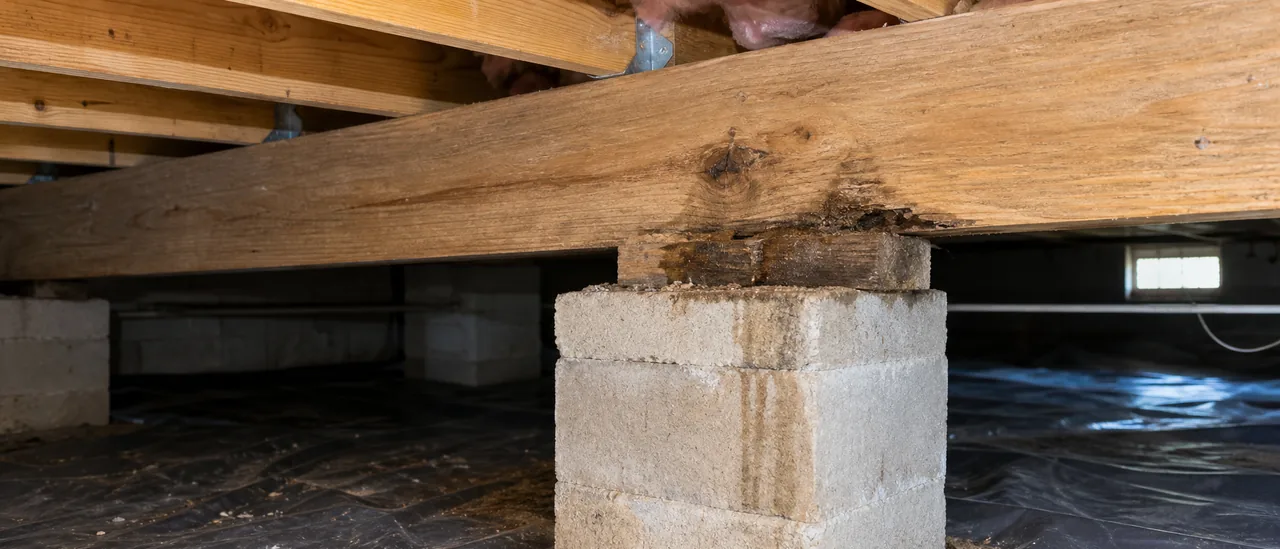
“Support beam” is an everyday term, not a precise diagnosis. Here it means an exposed or concealed wood member carrying part of the home’s load, such as a beam, girder, or built-up member. Surface discoloration alone does not confirm decay or establish how much load-carrying capacity remains.
Why rot may not be found
The ASHI Standard of Practice calls for inspection of readily accessible, visually observable systems and components, including foundations and framing. It also says an inspection is not technically exhaustive and need not identify concealed conditions or latent defects.
Common visibility limits include:
- drywall, paneling, flooring, or other finishes covering the member;
- insulation, stored belongings, equipment, soil, or debris blocking the view;
- a crawlspace opening or clearance too small for safe entry; and
- decay hidden inside a member while its exposed face appears sound.
Inspectors also avoid damaging the property. The ASHI standard does not require probing where that would damage a surface or where deterioration is neither visible nor presumed. Under InterNACHI’s standard, inspectors do not have to dismantle or uncover components, move stored items, or enter unsafe or inaccessible crawlspaces.
Visible evidence is not a structural capacity test
An inspector may report softness, fungal growth, staining, deformation, or other visible deterioration. Those observations can justify further evaluation, but a visual inspection cannot determine the member’s remaining strength or the full extent of concealed decay.
What the inspection should still cover
Access permitting, the inspector should examine structural components and document relevant observed conditions. InterNACHI’s standard specifically includes the foundation, basement, crawlspace, and structural components. It also requires reporting observed active water penetration and certain visible framing alterations that may present a structural or safety concern.
Read the report for more than the word rot. Look for moisture staining, wood deterioration, sagging or uneven framing, restricted access, areas not inspected, and recommendations for further evaluation. The report should state why a required area or component was not inspected.
Practical bottom line
A missed beam does not automatically prove the inspection was improper. The key questions are whether the member was visible and readily accessible, whether warning signs were present, what standard and agreement governed the inspection, and whether the report disclosed limitations.
If significant deterioration or movement is visible, avoid treating a home inspector’s observation as a structural conclusion. A structural engineer can evaluate capacity and repair needs; additional invasive access should be coordinated with the property owner and an appropriately qualified professional.