On this page
Yes, roots can be missed
Yes, a home inspector can miss tree roots in a sewer line, especially when a sewer-camera scope was not included or the pipe could not be fully viewed.
A standard home inspection is visual and limited to readily accessible systems and components. The American Society of Home Inspectors standard also does not require inspection of underground items or dismantling systems. Because the buried sewer lateral is neither exposed nor visible from ordinary access points, roots inside it may remain undetected.
The service agreement matters. Some inspectors offer sewer scoping as an additional service when their qualifications and local rules allow it. That does not make a camera inspection part of every general home inspection. The report and agreement should say whether the lateral was scoped, where the camera entered, and how far it traveled.
A plumbing check is not automatically a sewer scope
Running fixtures can show whether water drains during the inspection. It does not provide a view inside the buried lateral or rule out root intrusion farther downstream.
What visible findings can establish
An inspector may observe slow drainage, a backup, gurgling, sewer odor, or evidence of previous leakage. Those conditions can justify further evaluation, but none confirms that roots are the cause. Grease, debris, damaged piping, an offset joint, or another obstruction can produce similar concerns.
Likewise, a large tree near the sewer route does not prove its roots entered the pipe. The tree’s location is context, not a diagnosis. Without a view inside the line, the inspector cannot identify a root mass, its location, or how much of the pipe it blocks.
What a sewer camera can—and cannot—confirm
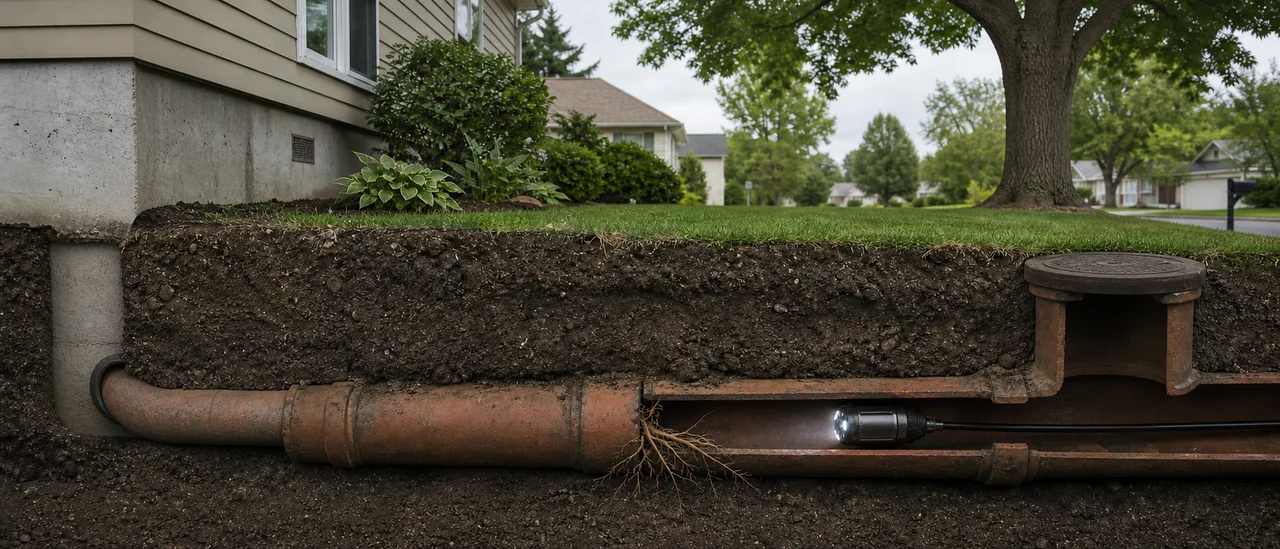
A sewer scope sends a camera through an accessible cleanout or another suitable opening. Official Lake County guidance says a video inspection can show roots, cracks, grease, and offset joints affecting sewer flow. When the image is clear, the operator can document visible root intrusion and its approximate position in the viewed section.
Access still creates limits. If the camera cannot traverse the entire line or the view is obscured, part of the pipe remains unexamined. A scope cannot confirm the condition of a section it never reaches or cannot show clearly. It also may not identify which specific tree produced the roots.
Practical bottom line
Read the inspection agreement and report before deciding something was overlooked. If no sewer scope was ordered, hidden roots may have been outside the inspection’s scope rather than visibly missed.
When the report notes drainage concerns, inaccessible sections, or an incomplete camera run, a qualified sewer or plumbing professional can evaluate the lateral. Ask for the video, the access point, the distance inspected, and any unviewed sections so the conclusion stays tied to what was actually seen.