On this page
Most inspections do not include every receptacle
No, home inspectors generally do not test every outlet; the applicable standard usually requires a representative number of accessible receptacles instead. The inspection agreement or local rules may set a different scope, and an inspector may voluntarily test more.
“Outlet” is the familiar term, but inspection standards often use receptacle for the device where a plug connects. Electrical outlets can also include other points where wiring supplies equipment, so the report’s wording matters.
Washington’s home-inspector rules offer a direct example. They require verification of a representative number of accessible switches, receptacles, and light fixtures. They also expressly state that the inspector need not test every switch, receptacle, and fixture. Maryland’s minimum standards likewise allow inspectors to base findings on a representative number of electrical outlets.
Need every receptacle checked?
Ask before the inspection whether receptacle-by-receptacle testing is available. A standard report based on representative sampling is not an outlet-by-outlet clearance.
What inspectors can check at a receptacle
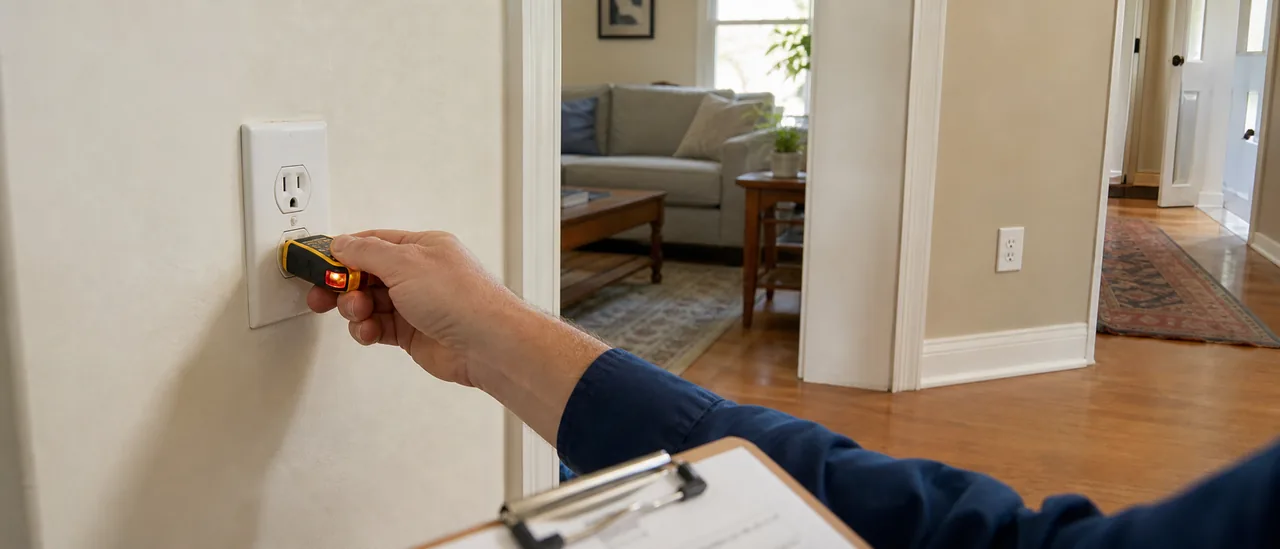
At selected accessible receptacles, an inspector may use a plug-in tester or other normal controls to check operation. Depending on the governing standard, the inspection may also address polarity, grounding, and ground-fault or arc-fault protection.
Those checks have limits. A simple tester can identify certain conditions at the tested location, but a visual, non-invasive home inspection is not a technically exhaustive electrical evaluation. Maryland’s standard describes the inspection as visual and focused on readily accessible systems; it is not intended to uncover concealed or latent defects.
An inspector also may not reach receptacles behind furniture, appliances, or stored belongings. Washington’s rule does not require moving objects, furniture, or appliances to access electrical components. Unsafe conditions can further limit testing.
How to interpret the report
Read the electrical section for three kinds of information:
- defects found at the receptacles that were tested;
- locations or components that were inaccessible or not inspected; and
- recommendations for further evaluation when the observed condition needs diagnosis.
A reported defect at one receptacle should not be treated as proof that every receptacle has the same problem. The reverse is also true: several satisfactory test results cannot confirm the condition of all untested devices or wiring hidden inside walls.
For repeated failures, signs of overheating, loose or damaged devices, or questions about concealed wiring, a qualified electrician can perform a more focused evaluation. Avoid removing covers or probing a receptacle yourself.