On this page
The direct answer
No, a standard condo inspection does not necessarily cover common areas; they are included only when the inspection agreement expressly adds them and access is available.
InterNACHI’s residential Standard of Practice specifically says inspectors are not required to inspect common elements or areas in multi-unit housing. It also allows the client and inspector to modify the scope before the inspection. State rules, the inspector’s standard, and the signed agreement may differ, so “condo inspection” is not a universal promise to inspect the whole development.
Scope and ownership are different questions
A buyer may receive an ownership interest in shared property without receiving a full physical inspection of it. Condominium documents define unit boundaries and common elements; the inspection agreement defines what the inspector will examine.
What the inspector may observe
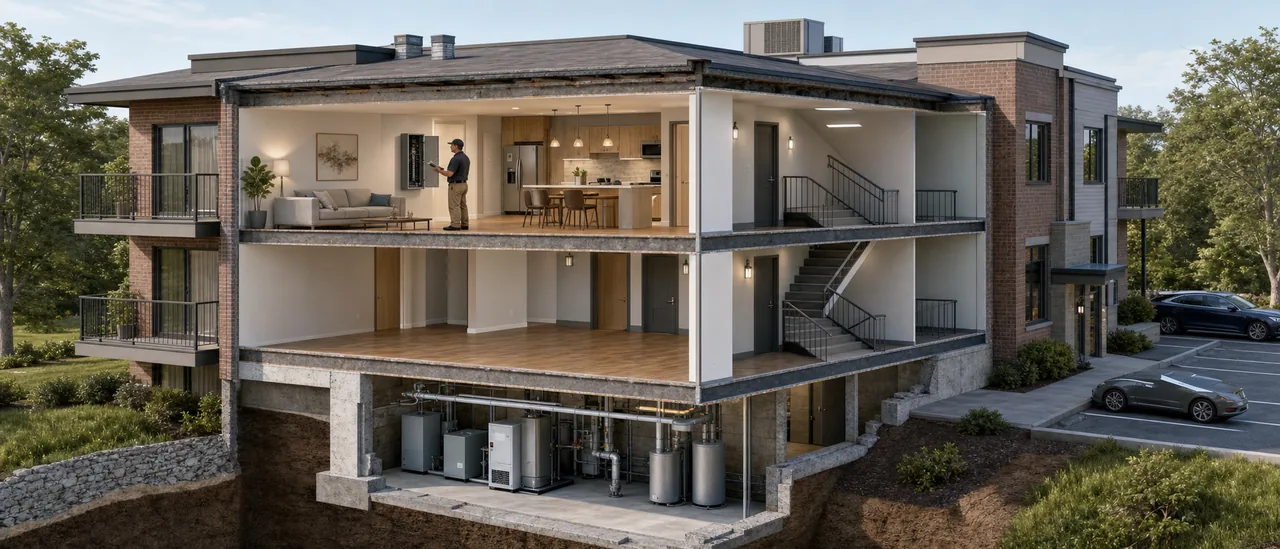
The normal focus is the unit and the systems serving it. Depending on the agreed scope, an inspector might also observe an assigned balcony, nearby hallway, parking space, exterior surface, roof, foundation, mechanical room, or other shared component.
An observation is not the same as a comprehensive common-area assessment. The report should identify what was inspected, what was excluded, and any access limitation. Permission from the owner, association, or property manager may be necessary for locked roofs, utility rooms, crawlspaces, or equipment areas.
What a visual inspection cannot confirm
Home-inspection standards describe a limited, visual process. ASHI requires inspection of readily accessible, visually observable, installed systems and components. Its definition of “readily accessible” excludes conditions requiring destructive measures, moving property, or actions likely to risk people or property.
That means even an expanded common-area scope cannot confirm every concealed defect. It generally does not establish engineering adequacy, predict future performance, or evaluate every repeated component. The inspector may note visible staining, deterioration, unsafe conditions, or apparent malfunction, but those observations do not prove the condition of hidden assemblies.
Confirm the scope before the appointment
Ask for the agreement in writing and compare it with the condo declaration, plans, and association information. In particular, clarify:
- whether the roof, exterior, structure, grounds, garages, and shared mechanical systems are included;
- which areas require association access or advance permission;
- whether exclusive-use areas, such as a balcony or assigned parking space, are included; and
- how excluded or inaccessible components will appear in the report.
The practical bottom line is simple: assume common areas are excluded until the written scope says otherwise. If a shared structure or system raises a specific concern, arrange a qualified evaluation with the required access rather than relying on a unit-only inspection.