On this page
Accurate for visible conditions, but not conclusive
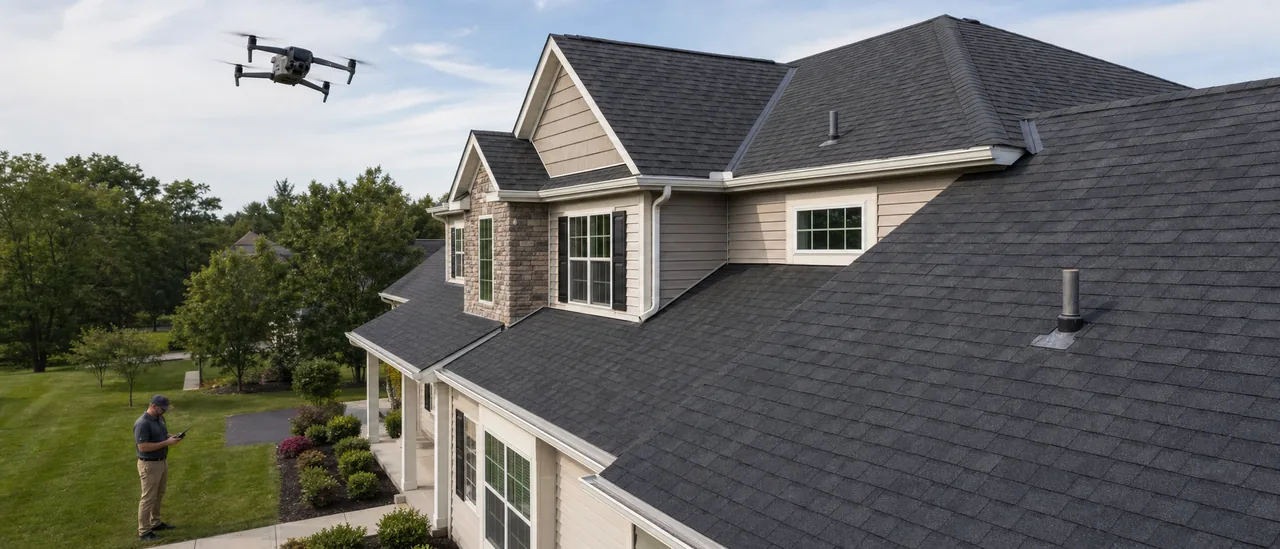
A drone roof inspection can accurately document many visible surface conditions when the images are sharp, close enough, and complete. It is best understood as a remote visual inspection—not proof of what is happening beneath the roof covering.
Accuracy also depends on the question being asked. Locating an obvious open seam is different from diagnosing a leak source, confirming trapped moisture, or measuring a small impact mark. There is no responsible single accuracy percentage for every drone, roof, defect, and inspection method.
What the evidence shows
In one 2020 study of a low-slope roof, an experienced roofing inspector found 191 specific deficiencies in a drone-derived 3D model and 200 during an in-person inspection. Open laps, punctures, wrinkles, surface cracking, and edge damage were easier to identify remotely. Blisters and damage near penetrations were among the harder conditions to count or measure.
That result shows why drone imagery can be highly useful without being interchangeable with physical access. A good flight can create an orderly, reviewable record of roof planes, flashings, penetrations, drainage areas, displaced materials, and other exposed details. It cannot touch a soft area, lift an edge, inspect an attic, or see through an opaque assembly.
“Visible” is the key limit
A drone can confirm that a feature appears in its usable imagery. It cannot, from that appearance alone, establish a hidden condition, exact cause, remaining service life, or repair scope.
What changes the result
The inspection is more dependable when the operator captures overlapping views at a useful scale and includes steep slopes, valleys, eaves, ridges, penetrations, and roof-mounted equipment. Reliability falls when glare, deep shadow, rain, wind-driven movement, tree cover, dirty surfaces, distance, or an obstructed angle hides detail.
The camera and review method matter too. Ordinary color images document visible surfaces. Photogrammetry can organize overlapping images into a measurable model, but its measurements depend on capture geometry, scale, processing, and suitable reference or control. Automated defect detection adds another variable: a 2022 residential-roof study reached 81% validation accuracy for one narrowly defined task—identifying missing shingles—and missed 19% of defects, mainly because defects were small or photos were poor.
Thermal imaging does not remove the need for interpretation. It records surface temperature patterns, not moisture itself. NIST guidance notes that roof construction, equipment, and material differences can produce responses resembling moisture; selected roof cores may be needed to confirm observations.
Practical bottom line
Treat a drone inspection as strong evidence for accessible, visible roof conditions when coverage and image quality are documented. Treat hidden moisture, substrate condition, leak causation, code compliance, and repair design as unanswered unless the stated inspection scope includes an appropriate confirming method. When a material concern remains uncertain, qualified hands-on or targeted evaluation is the sensible next step.