On this page
Start with the summary, then check the limits
Read the report summary first to locate safety concerns, significant deficiencies, and recommendations for further evaluation. Then read the entire report. A summary is a navigation aid, not a substitute for the inspector’s descriptions, photographs, and limitations.
Next, find the inspection agreement, scope, standards of practice, and list of excluded or inaccessible areas. ASHI’s standard covers installed systems and components that are readily accessible and visually observable. It also requires the report to identify designated components that were present but not inspected, along with the reason.
A report records a point in time
A standard inspection describes observed conditions on the inspection date. It is not technically exhaustive and generally does not confirm concealed defects, future performance, or repair cost.
Review every finding in the same order
Work through the report by system—structure, exterior, roof, plumbing, electrical, heating, cooling, and interior—and make a short action list. For each finding, record:
- Location: Which room, elevation, fixture, or component is involved?
- Observation: What did the inspector actually see or test?
- Meaning: Is it described as unsafe, not functioning, significantly deficient, or needing monitoring?
- Recommendation: Does the report call for correction, monitoring, or further evaluation?
- Access: Was the surrounding area fully inspected, partly visible, or excluded?
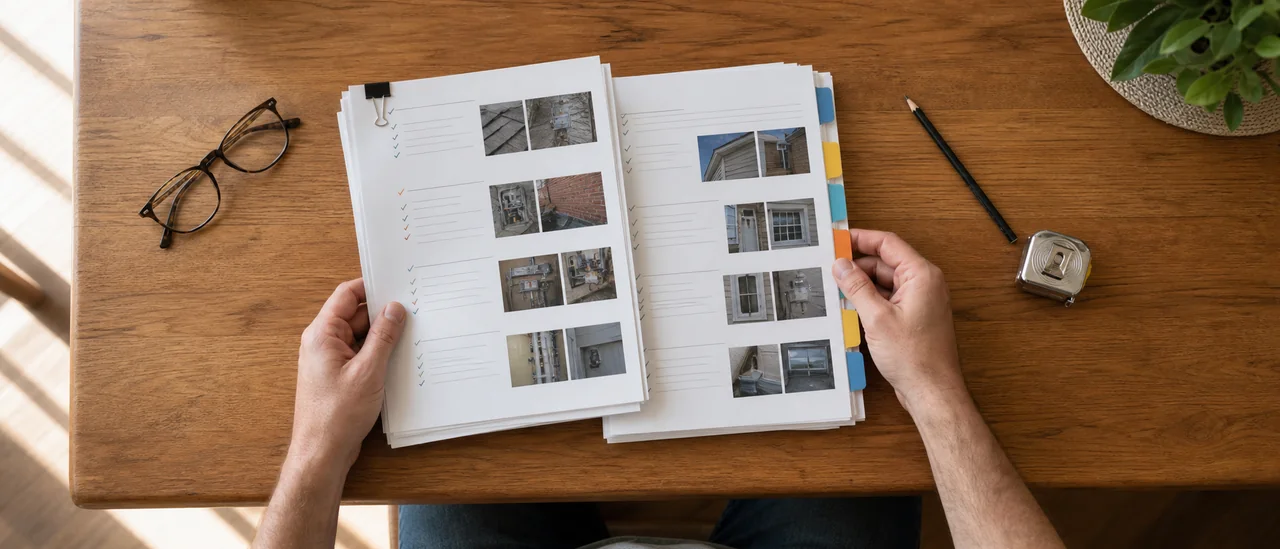
Match captions and arrows to the written location; a close-up photograph may not show scale or context. Also distinguish an age estimate from a condition finding. Under InterNACHI’s standard, being near or beyond a typical useful life is not, by itself, a material defect.
Put safety and uncertainty first
Create three practical groups: safety-related items, findings needing specialist evaluation, and routine corrections or monitoring. Address instructions in the report itself rather than ranking items by the number of photos or the length of a comment.
Do not open an electrical panel, climb onto a roof, enter a restricted crawlspace, or operate equipment to “double-check” a finding. Ask the inspector to explain unclear wording or reconcile a photo with the narrative.
Know when the report cannot answer the question
A visual inspection can document visible staining, cracking, corrosion, damage, or abnormal operation. It usually cannot establish a concealed condition, the cause of every deficiency, remaining service life, structural adequacy, or the exact repair method and price. ASHI’s standard expressly excludes those determinations unless the inspector’s agreed scope goes further.
Seek the qualified specialist named or implied by the finding when diagnosis exceeds a general inspection—for example, a licensed electrician for an electrical concern or a structural engineer for structural adequacy. Give that specialist the relevant report pages and ask for a written diagnosis and scope. Finally, confirm which questions remain open with the inspector; the report should guide the next evaluation, not be stretched into conclusions it cannot support.