On this page
The typical time
For planning, one to two hours on site is one provider's estimate for most residential septic inspections. It is not an industry standard: system design, access, testing requirements, and local rules can make the visit shorter or substantially longer.
The estimate applies to a conventional residential system whose components are known and reasonably accessible. It may not include excavation, tank pumping, laboratory work, repairs, or the time needed to issue a final report.
Confirm what “inspection” means
A routine visual maintenance inspection and a property-transfer functional inspection are not the same scope. Ask whether the quoted time includes locating and opening components, pumping, flow or dye testing, and report preparation.
What fits into the time estimate
Tri-County Pumps, a regional septic service provider, says most residential inspections take one to two hours, depending on system type, size, and access. That estimate describes its own stated inspection duration; confirm the scope and expected time with the person performing your inspection.
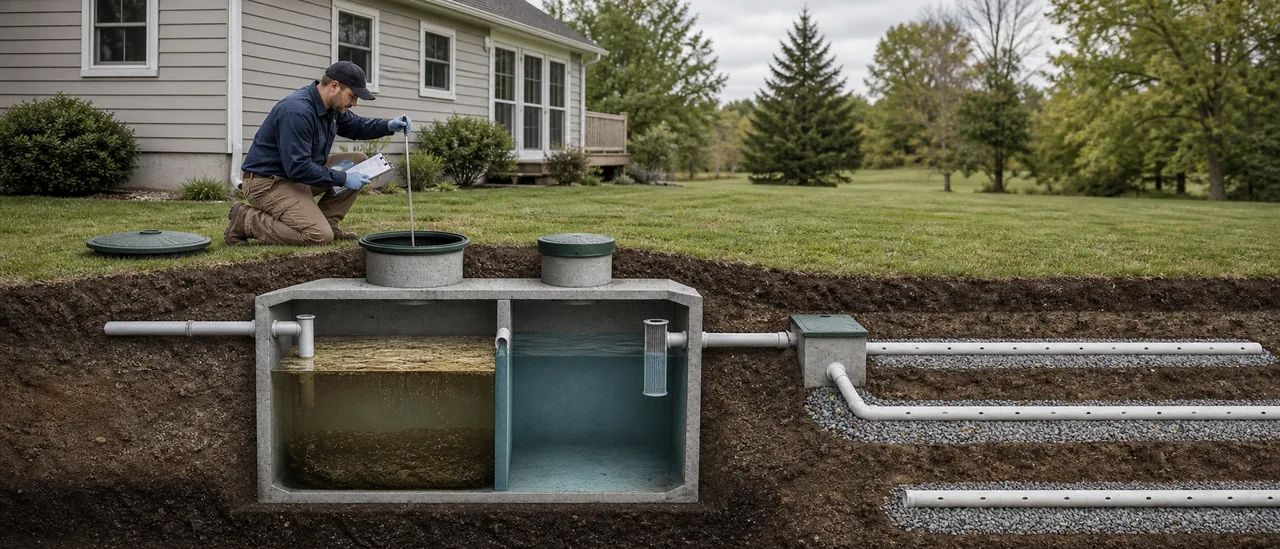
EPA describes a typical inspection as reviewing system and maintenance records, opening and checking tanks, measuring sludge and scum, examining the filter, tank, pipes, pumps, controls, and wiring, and evaluating the drainfield and distribution box. Camera work or limited excavation may also be appropriate.
InterNACHI distinguishes a visual maintenance inspection of major components from a functional inspection, which is used mainly for property transfers and is designed primarily for licensed septic contractors. The selected scope therefore changes both the time and who should perform the work.
What can make the inspection take longer
Extra time is most likely when:
- records are missing and the tank or drainfield must be located;
- buried lids or the distribution box require digging;
- the system has multiple tanks, pumps, alarms, or advanced treatment components;
- pumping, a flow test, dye testing, or a camera scope is included;
- standing water, damage, or another concern requires closer evaluation; or
- a local transfer program requires repeated visits or specific documentation.
Local requirements can change the timeline dramatically. For example, Erie County, New York, says its property-transfer inspection typically spans three days, with staff at the property for about 1½ hours on each day. That specialized government process should not be mistaken for a single private inspection.
What the visit can—and cannot—confirm
An inspector can document accessible component condition, liquid and solids levels, visible leakage or backup evidence, mechanical operation, and surface signs around the drainfield. Those observations describe conditions at the inspection.
They do not guarantee future performance or reveal every buried defect. Pipe interiors generally require a camera, while subsurface drainfield conditions may require probing or excavation. Weather and recent water use can also affect what is observable.
Practical bottom line
If your inspector quotes roughly two hours, ask what that time includes. When access is uncertain, pumping is required, the system is complex, or a jurisdiction prescribes a transfer test, allow additional time and confirm when the written report will arrive.