On this page
Typical cost in 2026
As of August 2026, repairing about 20 feet of bulging or bowed basement foundation wall often costs $1,600 to $11,000. A typical project is around $4,500. The repair method, wall length, and degree of movement usually change the price most.
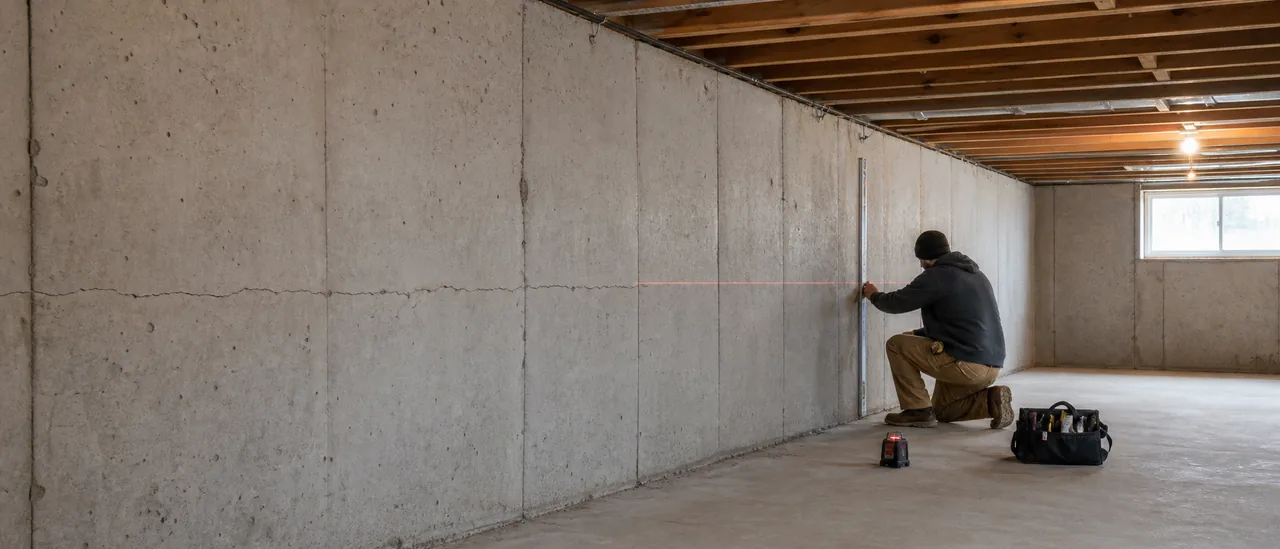
Here, “bulging” means a foundation wall that curves or bows inward. It does not mean an isolated crack, a leaning retaining wall, or settlement beneath the footings; those conditions have different repair scopes and budgets.
| Planning scenario | Illustrative budget | Likely scope |
|---|---|---|
| Low | $1,600–$2,800 | Anchors on roughly 20 feet of wall where the specified method and exterior access allow them |
| Typical | About $4,500 | Stabilization using a method selected for the wall’s condition and dimensions |
| High | $6,000–$11,000+ | Tiebacks or straightening; extensive damage, reconstruction, or related work can cost more |
These are national planning figures, not a diagnosis or quote. Another 2026 guide places reinforcement and stabilization at $4,000 to $12,000 for 12 strips, showing how unit count and scope shift published ranges.
What a repair estimate may include
A wall-stabilization quote commonly covers the specified anchors, straps, braces, or tiebacks; installation labor; fastening at the top and bottom; and basic cleanup. Straightening costs more than stabilizing a wall in its current position because it adds labor and may involve excavation or relieving soil pressure.
Read the exclusions as carefully as the total. Engineering, permits, excavation, soil testing, drainage correction, crack sealing, waterproofing, utility relocation, and replacement of finished walls may be separate. Comparing bids is useful only when each contractor prices the same written scope.
Stabilization is not always straightening
A stabilization plan may be intended to prevent additional movement without returning the wall to a perfectly vertical position. The estimate should state the intended result, not merely name the hardware.
What changes the price most
The chosen repair method drives the starting price. Published 2026 figures for a 20-foot wall range from $1,600–$2,800 for wall anchors and $1,700–$5,000 for steel or carbon-fiber straps to $6,000–$7,200 for helical tiebacks. Wall straightening with reinforcement is listed at roughly $6,700–$11,000.
Length and height affect the number and size of supports. The amount of inward movement, cracks, displaced masonry, and whether the wall is still moving can change the engineered repair—not just add a little labor.
Access matters on both sides. Finished walls may require demolition and restoration, while decks, patios, tight lot lines, or hard soil complicate exterior excavation. Drainage work can be separate from the brace price.
Location matters too. A national construction estimator uses area modification factors because material, labor, and equipment costs vary by job site. Permit rules, design requirements, and contractor availability also differ locally, so a national range should be replaced with itemized local estimates.
When to obtain specialist estimates
A standard home inspection can identify visible foundation and framing conditions, but the ASHI standard does not require engineering analysis or an opinion on structural adequacy. When a wall is visibly bowed, movement is changing, masonry is displaced, or the correct method is unclear, a structural engineer or other appropriately qualified specialist can define the repair objective before contractors price it.
Ask for estimates that list wall length, support spacing, connections, access work, permits, finish restoration, drainage work, warranties, and exclusions. That makes the totals comparable and exposes costs that a one-line proposal can hide.