On this page
The 2026 cost range
As of July 2026, budget about $150–$450 to repair a loose stair rail, $300–$700 to replace a standard 10-foot railing, or $500–$1,300 for professional installation of a missing stair-railing system. The biggest variables are the failed attachment, railing length and material, and whether the work requires custom fabrication or finish matching.
These are national planning ranges, not bids. A small repair may still carry a minimum service charge, while local labor rates and difficult access can push an otherwise simple job higher.
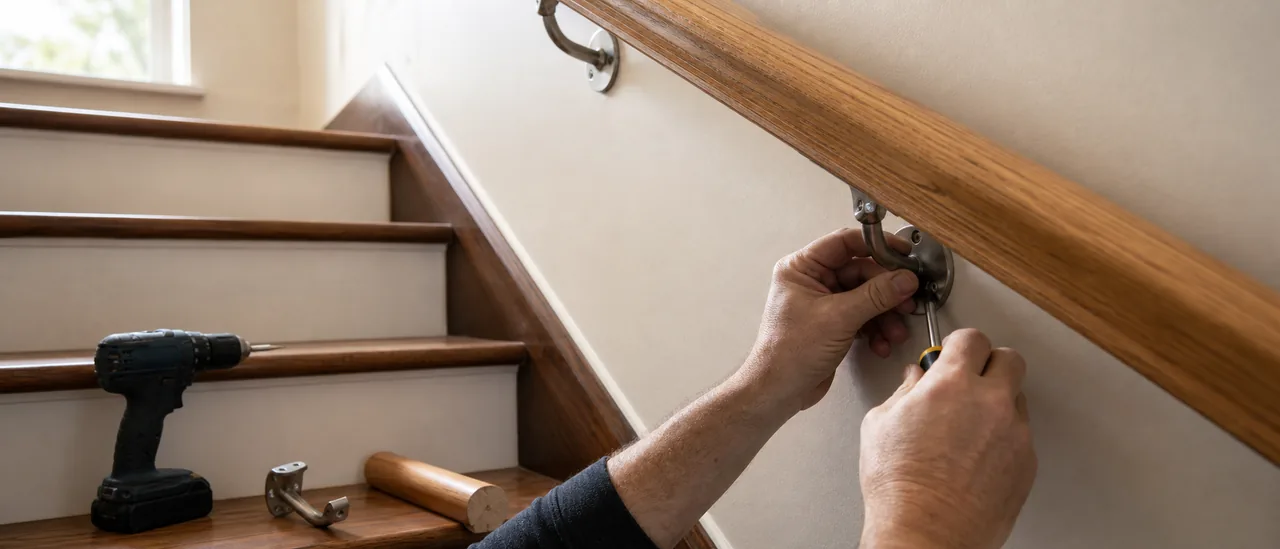
In everyday speech, “handrail” and “railing” often overlap. Here, the handrail is the graspable member used while climbing or descending. A railing system may also include posts and balusters, so a missing system costs more than replacing only its handrail.
What different scopes may cost
| Scenario | 2026 planning range | What usually changes the total |
|---|---|---|
| Low: reattach a loose rail | $150–$450 | New fasteners or brackets; accessible wall or post attachment |
| Typical: replace a 10-foot railing | $300–$700 | Rail material, removal, and finish matching |
| High: install a missing system | $500–$1,300+ | Posts, balusters, custom turns, premium materials, and site repairs |
Fixr’s January 2025 estimate places loose-rail repair at $150–$450 and general handrail repair at $100–$500. It lists $300–$700 to replace a standard 10-foot railing. HomeAdvisor’s June 2026 installation survey reports a $500–$1,300 normal range and a $900 average.
The table separates scopes because one “loose handrail” can describe very different work. Tightening a wall bracket is not comparable to rebuilding a loose newel post or fabricating a curved metal rail.
What an estimate should include
A useful estimate identifies the affected components and states whether repair or replacement is planned. It should account for labor, fasteners or brackets, the rail or posts being replaced, removal of damaged material, and ordinary cleanup.
Ask whether painting, staining, welding, wall patching, or floor and stair repairs are included. HomeAdvisor reports general-contractor labor of $70–$150 per hour for stair-railing installation. That spread helps explain why small jobs can vary even when materials are inexpensive.
Budget ranges cannot reveal the failed connection
A rail can move because of loose hardware, a weak wall anchor, a damaged post, rot, or deterioration in the supporting stair. The visible wobble alone does not establish the repair scope.
The main price drivers
- Attachment and substrate: Refastening into sound framing is simpler than opening a wall or repairing deteriorated wood.
- Length and layout: Long runs, turns, landings, and curved stairs require more material and fitting time.
- Material: Standard wood is often easier to modify onsite. Ornamental metal, glass, cable, or custom profiles may require specialty fabrication.
- Exterior exposure: Corrosion, rot, coatings, and weather-resistant connections can add preparation and repair work.
- Finish matching: Blending stain, paint, metalwork, or older profiles may cost more than installing a basic compatible rail.
- Location: Labor rates, travel, permitting practices, and contractor minimums vary by market.
When to get a specialist estimate
Obtain a qualified onsite evaluation when the rail is missing, the post or surrounding stair moves, wood is decayed, metal is cracked, or the attachment point is unknown. A carpenter may handle conventional wood work; metal or glass assemblies can require the corresponding specialist.
Request a written scope that distinguishes the graspable handrail from guards, posts, balusters, and stair repairs. That distinction makes competing estimates easier to compare and keeps a $100 hardware fix from being confused with a four-figure railing rebuild.