On this page
Typical tie-down repair cost in 2026
As of July 2026, published local examples run from $800 for a single-wide retrofit in Florida to $5,800 for full anchor-and-strap replacement on a double-wide in Alaska. These installer prices cover different repair scopes, not inspection-only work. Home width, the number of components replaced, and site conditions change the price most.
There is no reliable national rate card in the sources reviewed. Use these figures only as regional reference points before obtaining a property-specific estimate.
| Published example | Listed scope | Provider's price |
|---|---|---|
| Florida | Single-wide tie-down retrofit | $800–$1,400 |
| Florida | Double-wide tie-down retrofit | $1,200–$2,200 |
| Florida | Over-the-top plus frame hurricane retrofit | $1,500–$3,500 |
| Alaska | Straps along one side of a typical single-wide | $1,200–$2,200 |
| Alaska | Full anchors and straps, single-wide | $2,400–$4,200 |
| Alaska | Full anchors and straps, double-wide | $3,600–$5,800 |
What the estimate should include
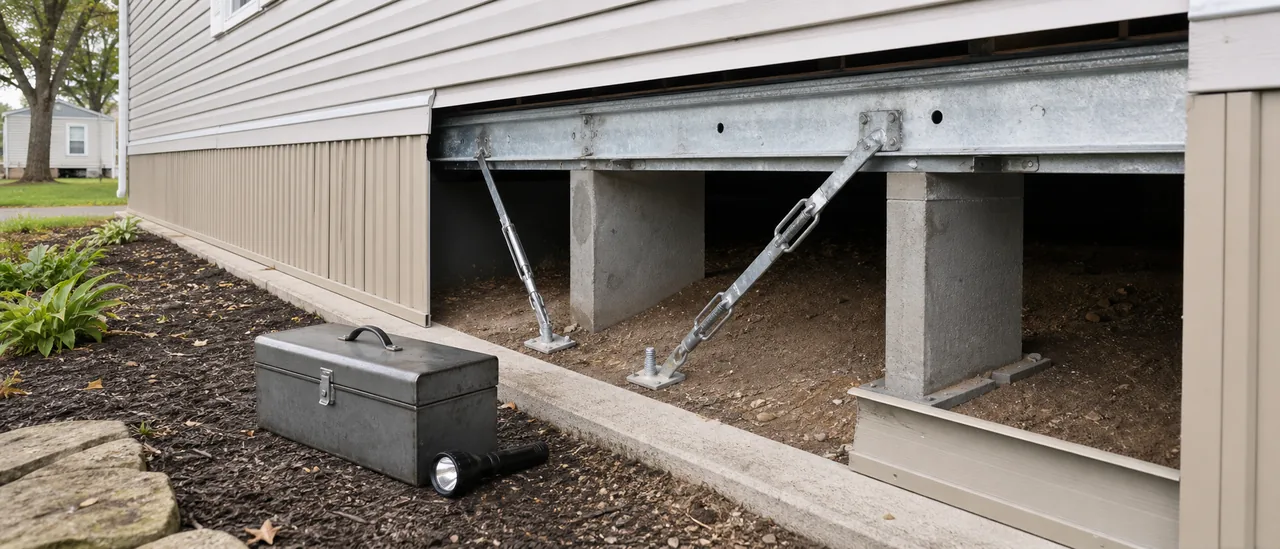
“Tie-downs” is useful shorthand, but the anchoring system includes more than straps. Federal definitions distinguish the anchor assembly that transfers loads to the ground from anchoring equipment such as straps, cables, turnbuckles, chains, and tensioning devices.
A useful estimate should state which anchors, straps, connectors, and stabilizer plates will remain or be replaced. It should also identify labor, skirting removal and reinstallation, disposal, inspection or permit allowances, and any documentation. Re-leveling, pier repairs, drainage work, and an engineer’s letter may be separate.
A loose strap does not reveal the whole scope
The visible strap may need tensioning, but a corroded connector, displaced ground anchor, unsuitable anchor for the soil, or altered support system can require different work. Ask for the finding and repair method in writing.
What changes the price most
Number of affected components: Re-tensioning one sound connection costs less than replacing anchors and straps around a single- or multi-section home. A wider or longer home can require more connection points and more labor.
Soil, wind design, and repair method: Federal anchoring rules tie anchor selection and spacing to the home’s installation instructions, design loads, and site conditions. Rocky, soft, saturated, or frost-affected ground may prevent a routine auger-anchor replacement. An alternative system or site-specific design can add equipment and professional fees.
Access and related work: Removable skirting and clear perimeter access keep labor down. Masonry enclosures, tight crawl areas, utilities, decks, or additions can slow the work. If the home must be leveled or supports corrected first, that work should appear as a separate line item.
Location and approvals: Labor and travel differ by market. Permit, inspection, and reinspection charges also vary by jurisdiction. Ohio, for example, publishes a $100 additional-inspection fee when another trip is required; that figure is an example, not a nationwide allowance.
When to obtain specialist estimates
Get an evaluation from a qualified manufactured-home installer or other locally authorized specialist when anchors are displaced, straps are broken or heavily corroded, the home has shifted, or the correct system is unclear. The federal standard requires anchoring instructions to address spacing, connection details, strap angles, and stabilizer plates, so a repair cannot be sized reliably from one photograph or a strap count alone.
For a broad retrofit, compare itemized estimates based on the same written scope. Confirm the home sections covered, hardware and soil assumptions, access work, leveling exclusions, permits, inspections, engineering, and final documentation.