On this page
Typical walkway trip-hazard repair cost in 2026
As of August 2026, budget $726 to $2,485 for professional repair of trip hazards in a concrete walkway. This national planning range generally covers labor, ordinary materials, and basic equipment. The repair method, affected area, and local labor or minimum service charge change the total most.
Limited work can fall around $400 to $1,000, while replacing a small slab may cost $1,000 to $3,000 or more. These ranges overlap because contractors may grind a raised edge, lift a sunken slab, or remove and repour concrete. They are not interchangeable solutions.
A trip hazard is a condition, not a repair method
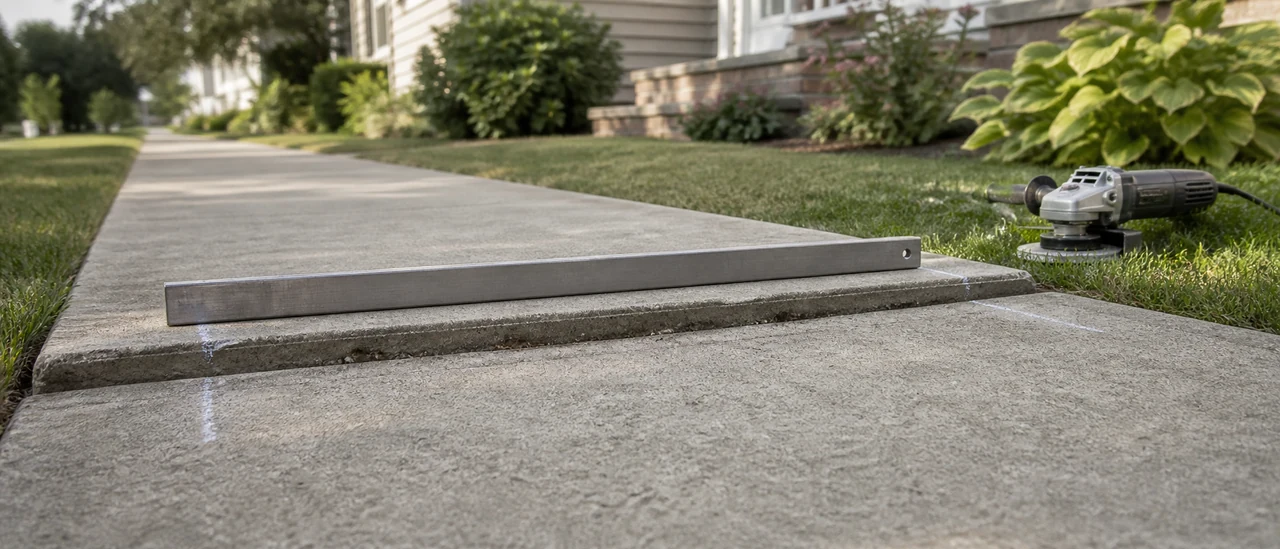
For budgeting, the term can describe a raised joint, sunken slab, heaved paver, or other abrupt level change. On accessible routes, federal standards address vertical changes above 1/4 inch, but those rules do not determine every private residential repair. Property type and local requirements still matter.
Low, typical, and high planning scenarios
| Scenario | 2026 planning range | What the range represents |
|---|---|---|
| Low | $400–$1,000 | Limited repair across roughly 50–150 sq. ft. |
| Typical | $726–$2,485 | Professional concrete walkway repair |
| High | $1,000–$3,000+ | Small slab removal and replacement |
A separate 2025 market estimate placed overall sidewalk repair at $1,750 to $2,500, with a broader low-to-high span of $800 to $5,000. That comparison shows why a measured scope is more useful than one national average.
What the price should include
A written estimate should identify the affected joints or slabs, measured area, repair method, labor, materials, equipment, surface finishing, debris removal, and cleanup. For replacement, confirm whether demolition, hauling, base preparation, forms, reinforcement, concrete placement, and finish matching are included.
Permit fees, traffic control, tree or root work, drainage correction, excavation, utility coordination, and landscaping may be separate. Concrete demolition and disposal alone can add $2 to $6 per square foot, according to the 2026 estimate.
What changes the total
Repair method: Grinding is usually considered for a localized raised edge. Lifting targets a sound but sunken slab, while badly cracked, spalled, or repeatedly moving concrete may require replacement. Current market data places grinding around $5 to $10 per square foot, but small jobs can still trigger a contractor minimum.
Area and number of transitions: One uneven joint requires less setup and work than several scattered slabs. Mobilization can make a one-spot repair expensive per square foot even when the total remains modest.
Cause and access: Settlement, erosion, roots, or drainage problems can add work beyond smoothing the visible edge. Tight access for grinding or concrete removal also increases labor.
Material and finish: Pavers may need lifting and rebedding rather than grinding. A 2025 survey estimated concrete walkway repair at $8 to $11 per square foot, brick at $11 to $14, and stone at $14 to $17. Matching color, texture, pattern, or adjacent sections can raise the price.
Region and property status: Labor rates vary widely by market. Public sidewalks may also involve ownership questions, permits, inspection, or required construction details. Seattle, for example, requires a permit before sidewalk repair and distinguishes owner responsibility from damage caused by city infrastructure.
When to obtain specialist estimates
Obtain site-specific estimates when more than one slab has moved, the cause is unclear, roots or drainage are involved, or the walkway lies in a public right-of-way. A qualified concrete or paving specialist can determine whether grinding, lifting, resetting, or replacement fits the measured condition.
For a useful comparison, request two or three written estimates using the same repair area and exclusions. Ask how the finished transition will be checked and whether recurring movement requires a separate scope.