On this page
The 2026 cost range
In 2026, budget about $150 to $1,000 for a professional water-heater repair when there is no hot water. Many ordinary repairs fall around $200 to $750. That generally covers diagnosis, labor, and a common replacement part—not a new heater. The failed component, heater type, and local service charges cause the biggest swings.
This range is a planning figure, not a quote. Two national cost guides overlap but do not match exactly: Fixr lists $150–$750, while HomeAdvisor reports $228–$1,017 and a $615 national average. Their different data and update methods are one reason a single “correct” national price does not exist.
What the repair price includes
A normal estimate may combine a service or diagnostic visit, technician labor, and the part needed to restore heat. Ask whether the diagnostic charge applies toward the repair and whether taxes, travel, disposal, or after-hours service are separate.
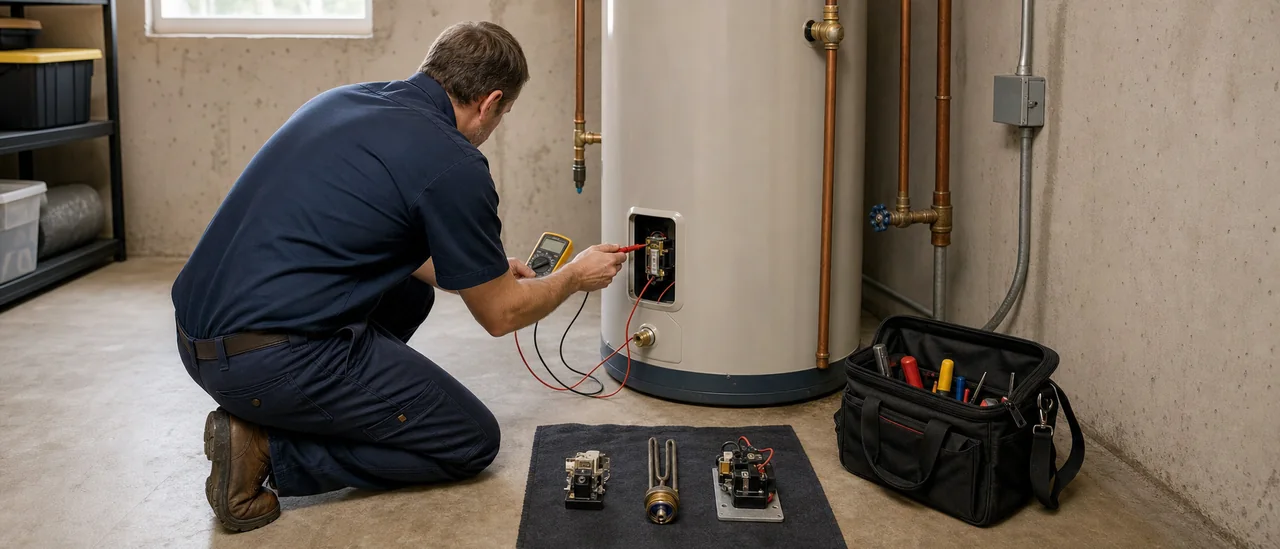
“No hot water” describes a symptom, not a diagnosis. On an electric unit, the work might involve a thermostat, heating element, wiring, or power-supply problem. A gas unit has different possible work, including pilot, thermocouple, burner, or gas-control components. Tankless and hybrid systems introduce other controls and parts.
Low, typical, and high scenarios
The table organizes budget scenarios rather than promising a price for a particular home.
| Scenario | Planning range | What may put the job here |
|---|---|---|
| Lower-cost repair | $150–$300 | Straightforward diagnosis; accessible thermostat, pilot, thermocouple, or valve work |
| Typical repair | $300–$750 | More labor, a heating element, multiple tests, or a costlier control part |
| Higher-cost repair | $750–$1,000+ | Tank, pump, complex controls, difficult access, urgent service, or more than one fault |
Published component estimates show why the symptom alone cannot predict the bill. Fixr lists thermostat replacement at $100–$250, thermocouple replacement at $150–$325, and heating-element replacement at $200–$750, all including labor. HomeAdvisor’s broader survey places gas-heater repairs at $150–$500 and electric repairs at $20–$300, illustrating how much assumptions can vary between guides.
What changes the estimate most
The actual failure matters first. Resetting or replacing a small control is different from tracing damaged wiring, replacing a pump, or addressing a compromised tank. A diagnostic visit separates these possibilities.
Heater design changes the parts and skills required. Storage-tank, tankless, gas, electric, propane, solar, and heat-pump units do not share the same repair profile. Specialized or unavailable parts may also extend the visit.
Property and regional conditions affect labor. Local rates, travel distance, permit requirements, equipment access, venting or electrical complications, and after-hours scheduling can raise the total. A cramped attic or closet usually takes longer to work in than an open utility room.
Keep repair and replacement estimates separate
A repair quote restores the existing heater. Replacement adds a new unit and may include removal, permits, code-related connections, venting, or electrical work. Confirm which scope an estimate covers before comparing totals.
When to obtain specialist estimates
Get a qualified evaluation when the cause is unknown, the breaker trips again, a gas unit will not stay lit, water is leaking, or the first estimate approaches replacement cost. Gas, combustion, and hard-wired electrical work require the appropriate licensed trade under local rules.
For an expensive or unclear diagnosis, request an itemized estimate. It should identify the failed part, labor, diagnostic charge, warranty, exclusions, and whether the technician recommends repair or full replacement. Comparing the same scope—not just the bottom-line number—produces the most useful decision.