On this page
Usually yes—when the test can answer a specific question
Repaired flashing should usually receive a controlled water test when the repair addressed an active or suspected leak. The main exception is when added water could damage the roof, enter unfinished work, void applicable requirements, or produce an unreliable result. In those cases, careful inspection and observation during natural rain may be the better verification plan.
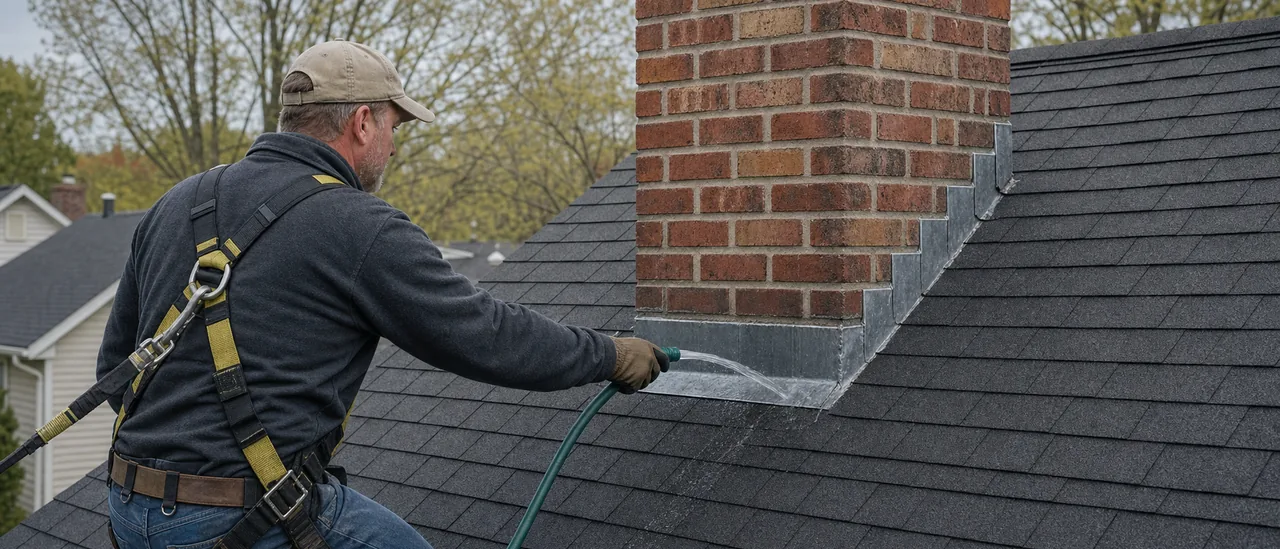
A water test is not simply spraying the entire roof. Its purpose is to challenge the repaired detail under a written, limited procedure while someone monitors the corresponding interior or concealed space. The test is most useful when the original leak can be recognized and the repair area can be isolated.
What supports testing
Flashing connects roof coverings to walls, curbs, chimneys, skylights, and penetrations. Those transitions must remain continuous with the roof's water-control layer and direct water downslope. The U.S. Department of Energy's Building America guidance calls for flashing around roof penetrations to be integrated continuously with that layer.
Testing adds useful evidence when:
- the repair followed a repeatable leak near a specific flashing detail;
- the interior side can be watched directly or checked with appropriate moisture-measurement methods;
- adjacent components can be wetted separately, starting at the lowest suspected area; and
- the procedure defines water application, duration, observation points, and stopping conditions.
A passing result increases confidence only for the conditions actually tested. Wind-driven rain, freeze-thaw movement, drainage backups, and long-duration storms may create conditions that a simple water stream does not reproduce.
“No leak observed” has limits
A negative test does not prove that every hidden layer is dry or that the detail will never leak. ASTM E1105, which applies to installed windows, skylights, doors, and curtain walls—not all roof flashing—notes that identical wind-driven wetting is difficult to simulate and that unobservable penetrating water may go unidentified. Record the method and observations rather than calling the roof “guaranteed watertight.”
When the answer changes
Do not substitute a flood test for a focused flashing test. Flooding a low-slope roof blocks drainage and places standing water over a broad area. NRCA-hosted guidance warns that this can damage roofing materials and make the leakage path difficult to verify; it also notes that ASTM D5957 is not intended for building roofing systems.
Postpone or redesign the test when the roof is unsafe to access, interior finishes cannot be protected, drainage is blocked, the assembly cannot tolerate the proposed water load, or the repair materials have not reached their required cure time. The applicable repair instructions and warranty conditions should control where they are more restrictive.
Inspection may be enough when the defect and correction are fully visible—for example, an open lap was properly re-formed and its integration with surrounding materials can be documented. A visual review can record loose metal, missing fasteners, open laps, unsealed corners, or corrosion. It cannot, however, confirm concealed laps or recreate a leak by itself.
What to document next
The record should identify the repaired location, pre-test condition, test sequence, approximate duration, interior observation area, results, photographs, and any limitations. If water appears, stop before avoidable damage spreads; the pathway may involve an adjacent wall, penetration, drain, or concealed connection rather than the repaired flashing alone.
When the correct method or safe scope is unclear, an experienced roof or building-envelope evaluator can design or observe the test. The goal is a defensible answer about one repair—not a dramatic rooftop rainstorm reenactment.