On this page
Most blisters involve trapped pressure or lost adhesion
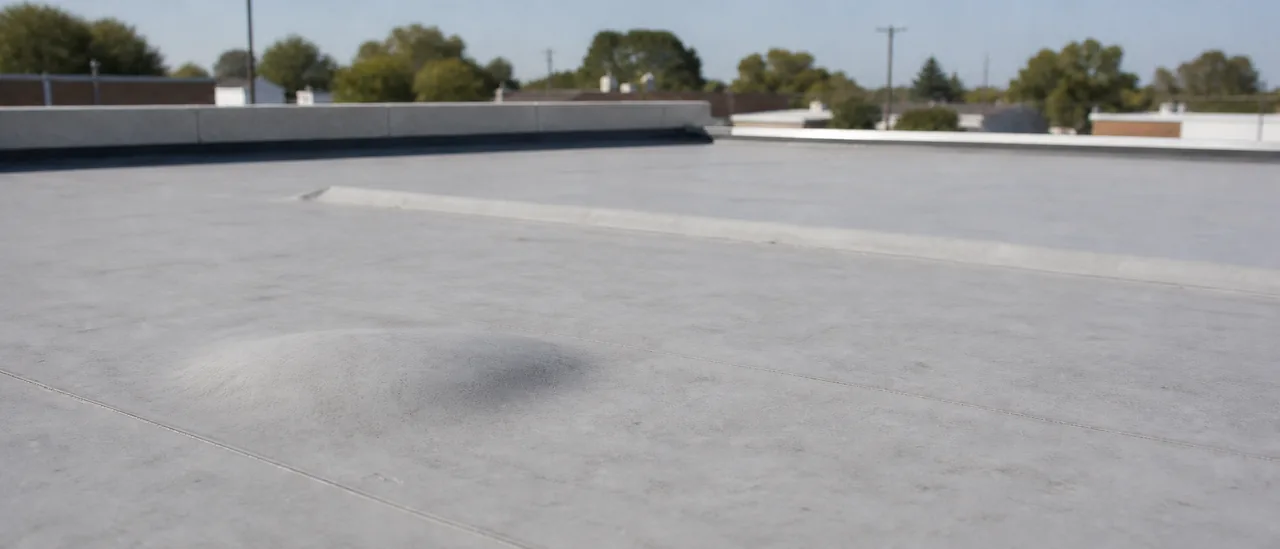
A membrane blister is a raised, enclosed area where roofing plies have separated or the membrane has detached from the layer below. The pocket may contain air, water vapor, liquid water, or solvent vapor. Sunlight can heat that pocket, increase its pressure, and make the raised area grow.
Moisture is a common starting point. It may come from wet materials installed into the assembly, an existing leak, humid indoor air moving upward, or residual moisture in a concrete deck. Poor surface preparation, contamination, excess or insufficiently cured primer, and incomplete bonding can also leave a void that later becomes visible.
The precise mechanism depends on the roof assembly. Built-up membranes may blister between plies. A fully adhered single-ply membrane can release from its substrate, while some fluid-applied membranes bubble when moisture or vapor escapes during application.
Bubbles have important look-alikes
Not every raised area is a blister. Its shape and behavior help narrow the possibilities.
| Visible pattern | More likely explanation |
|---|---|
| Rounded, enclosed dome | A void or adhesion loss containing air, vapor, or water |
| Long ridge or wrinkle | Membrane movement, aging felts, or an insulation-board edge showing through |
| Broad movement during wind or HVAC operation | Billowing or flutter in a mechanically attached membrane |
Ponded water is different again: it occupies a low area rather than lifting the membrane. A photograph alone usually cannot reveal which layer separated or what fills the pocket.
How the cause is confirmed
An evaluation starts by recording each raised area’s location, size, shape, firmness, and relationship to seams, drains, repairs, and traffic paths. Cracks, open laps, surface loss, or a change in size provide useful context. The evaluator also needs the membrane type, attachment method, roof history, and underlying construction.
Infrared imaging or another moisture survey can identify areas that may contain wet insulation. It does not, by itself, prove the cause of a particular blister. ASTM C1153 requires invasive verification of infrared findings; carefully selected test cuts or core samples can confirm layer order, moisture, and where adhesion failed.
Do not puncture a blister to “see what is inside”
Opening an intact membrane creates a new water-entry point and can complicate a proper repair. Sampling and resealing should follow the roof system’s requirements.
How urgent is it?
An isolated, firm blister is not automatically an active leak or an emergency. Some remain stable and are monitored. Prompt evaluation is more important when a blister is growing, water-filled, soft, cracked, located at a seam, or exposed to regular foot traffic. Interior leakage or an open split calls for faster action.
A qualified roof inspector or experienced roofing professional can determine whether monitoring, reinforcement, or removal and patching fits the membrane and assembly. Until then, keep people and equipment off the raised area and document any change without pressing or cutting it.