On this page
The best choice depends on the roof and the priority
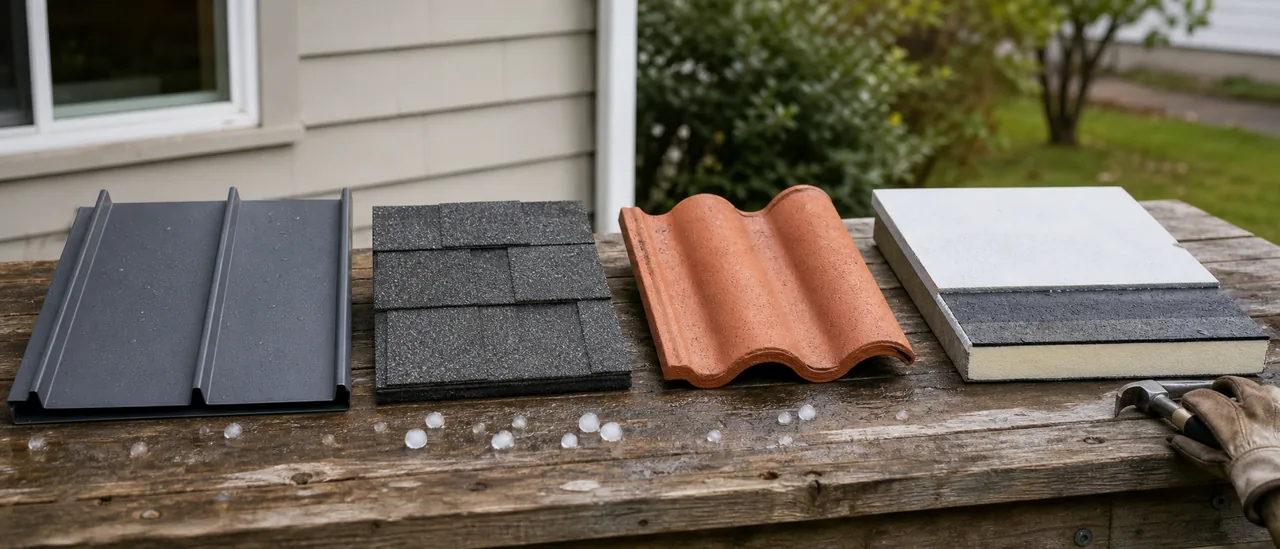
For a steep-slope home where preserving the covering matters more than a dent-free appearance, a UL 2218 Class 4 metal roof product is a strong choice. For a conventional shingle profile, choose an impact-resistant asphalt product rated Good or Excellent by IBHS. If tile suits the architecture, select a specific FM 4473 Class 4 product rather than assuming every clay or concrete tile resists hail equally.
There is no hail-proof roof. A material name alone also says less than the tested product, rating, support beneath it, and installation details.
Compare the options by consistent criteria
| Roof option | Rating to look for | Best fit | Important tradeoff |
|---|---|---|---|
| Metal panels | UL 2218 Class 4 | Functional resilience when cosmetic denting is acceptable | Hail can leave visible dents |
| Asphalt shingles | Good or Excellent IBHS rating | Conventional appearance and easier product-to-product comparison | Hail can dent, tear, or displace granules |
| Clay or concrete tile | FM 4473 Class 4 | Architectural preference for a rigid roof cover | Confirm the rating for the named tile product |
The “Class 4” label is the highest of four UL 2218 impact classes. UL says that test uses steel balls dropped from different heights. For asphalt shingles, it focuses on physical breach and does not account for visible denting or granule loss. That is why the separate IBHS rating adds useful product-to-product information for impact-resistant shingles.
Best choice by use case
Choose tested metal when visible denting is an acceptable tradeoff. FM’s current guidance notes that a dented metal roof can remain serviceable, although appearance changes. Performance still depends on the roof system, its substrate, and the tested configuration, so “metal” alone is not a performance rating.
Choose an IBHS-rated asphalt shingle when balancing resilience with a conventional roof. The current evaluation uses realistic laboratory hailstones and measures granule loss, dents, surface cracks, tears, and breaches. A Good or Excellent rating distinguishes performance among products already marketed as impact resistant.
Choose rated tile when architectural style leads. The 2025 FORTIFIED compliance form calls for FM 4473 Class 4 when its Hail Supplement is requested. The relevant rating belongs to the named product, not tile as a broad category.
What no rating can promise
Laboratory ratings compare controlled impacts on tested materials. Natural storms and roof configurations vary, while impacts can exceed a test’s size and energy. Ratings therefore improve selection; they do not guarantee that a roof will escape cosmetic marks, leakage, or damage in every storm.
Storm evidence is not a roof verdict
Radar can estimate hail conditions, and ground reports can document observed hail nearby. Neither confirms damage to a particular property. Confirmed damage requires property-specific physical evidence; a map cannot replace an inspection.
Compare the exact product listing and installation requirements, not just a brochure’s “impact-resistant” wording. If an existing roof’s condition is uncertain, a qualified roof evaluator can identify the material, document visible conditions, and explain what remains concealed.
Ratings and program requirements checked August 13, 2026.