On this page
Most often, the starter was omitted or only appears absent
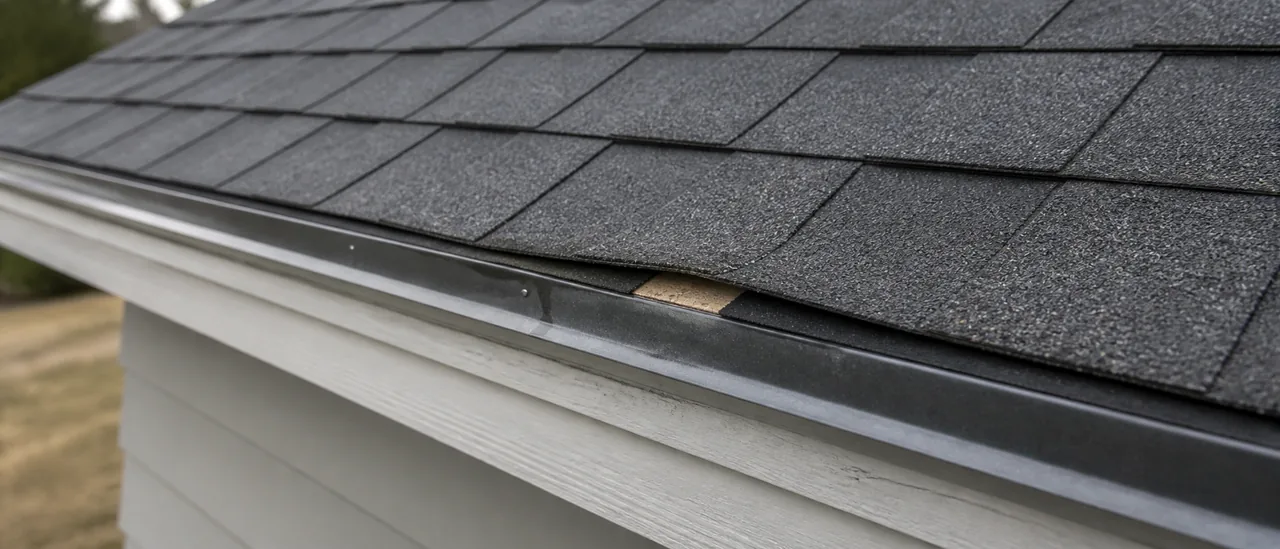
A truly missing starter course usually points to an installation omission, an incomplete edge repair, or wind-related displacement at a vulnerable roof edge. However, starter shingles sit beneath the first visible course, so an approved starter may be present but difficult to see.
Starter shingles form the concealed first layer along an asphalt-shingle roof’s eaves and, for some assemblies, its rake edges. They support the joints in the visible first course and help secure that exposed edge against wind.
“Missing starter shingles” should describe an absent or interrupted starter course—not merely an edge where no separate tabs are visible. Starter materials vary by assembly.
Why a starter section may actually be missing
The common causes are practical rather than mysterious:
- It was skipped during installation. An installer may have begun with the visible first course or left gaps at an eave or rake.
- A repair did not restore every layer. Edge-shingle, decking, or drip-edge work can disturb the concealed starter and leave a short gap.
- Wind displaced the edge assembly. Misplaced fasteners, poorly positioned adhesive, contamination, or an unformed seal can leave the starter and first course vulnerable.
- The damage is being mislabeled. The starter may remain while part of the overlying first course is missing, or a narrow starter may be hard to distinguish.
Independent building-science guidance says starter strips help protect roof edges against wind uplift. That function does not prove a particular storm caused a missing section.
How to confirm the condition
A ground-level photograph may show an irregular edge, exposed underlayment, or loose first course, but not every concealed layer. Confirmation requires safe edge examination against the installed system’s instructions.
The evaluator should check continuity, joint offset, fastener placement, and edge overhang against applicable instructions. The first course, drip edge, underlayment, and deck also need examination for movement or moisture.
A visible overhang is not proof
Shingle projection beyond the metal edge does not confirm a starter course underneath. Likewise, a flush-looking edge does not prove the starter is absent. The concealed layer must be identified directly.
Urgency depends on exposure and movement
Prompt evaluation is warranted when decking is exposed, edge shingles are loose, or water is entering. Keep clear of falling material, and do not climb onto a steep or damaged roof.
If the edge is dry, stable, and only looks unusual, the question is less urgent but worth resolving. A qualified evaluator can document whether the starter is missing, concealed, or inconsistent with installation instructions.