On this page
Ponding means water has no effective path off the roof
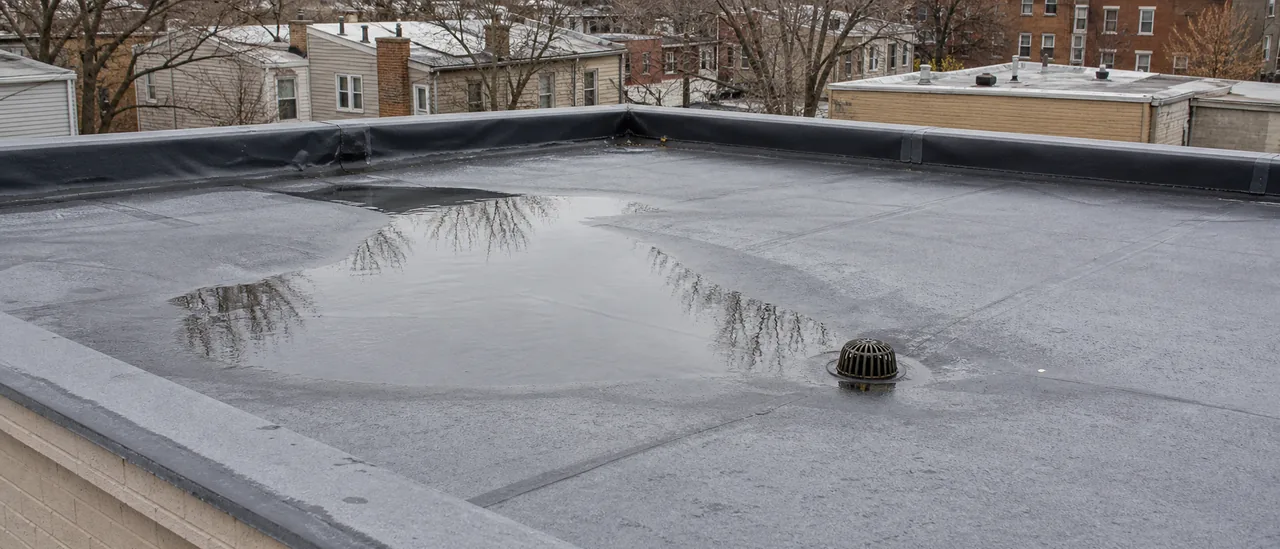
Ponding water usually means a low-slope roof is not draining completely. Despite the everyday term “flat roof,” these roofs should have a slight slope toward drains, scuppers, or edges.
A puddle immediately after rain is not automatically a defect. NRCA’s guidance judges drainage by whether water remains 48 hours after rain under conditions that allow drying. That distinction matters: a brief wet patch may be normal, while persistent standing water points to a drainage problem.
The location offers an important clue
Water gathered around a drain suggests the outlet may be slow, blocked, or set too high. A pond centered between supports more strongly suggests a depression or structural deflection.
Common causes range from simple to structural
Leaves, sediment, vegetation, or ice can obstruct a drain or scupper. Water can also arrive faster than an undersized or poorly arranged drainage system can remove it, especially during intense rain.
If the drainage openings are clear, the roof surface may not have enough slope. Other plausible causes include:
- a drain or scupper positioned above the surrounding surface;
- uneven decking, insulation, or roof-system layers that create a low spot;
- settlement or deflection of the deck or framing;
- curbs, equipment supports, or other details interrupting the intended flow path; and
- runoff or condensate from rooftop equipment repeatedly discharging in one area.
NRCA notes that construction irregularities, structural deflection, rooftop equipment, snow, traffic, and the roof system’s own load can produce concave areas. FEMA safety guidance similarly identifies poorly designed or blocked drainage as a cause of snowmelt ponding and warns that the collected water creates a concentrated roof load. These are possible mechanisms, not a diagnosis for every building.
Confirm the pattern, not just the puddle
Confirmation begins with timing and location. Note when rain ended, whether drying conditions followed, how long water remained, and whether the same outline returns after separate storms. From a safe location, look for debris at drainage points and whether water reaches them.
A qualified evaluation can then compare the roof’s elevations, drainage layout, and surface condition. It may also determine whether a depression is confined to roofing layers or reflects movement in the deck or framing. A photograph alone cannot establish that difference.
Do not block drains or add water to “test” the roof. Deliberately retained water adds load and can worsen an existing leak or drainage problem.
Urgency depends on persistence and warning signs
Arrange prompt evaluation when water remains beyond normal drying time, the pond is growing, the roof appears to sag, or leaks and interior staining accompany it. Active deformation, cracking sounds, or an unusually deep accumulation warrants keeping people out of the area below until a qualified professional assesses it.
A shallow puddle that disappears soon after rain is less urgent, but recurring water in the same spot still deserves monitoring. The useful next step is to determine whether the cause is routine obstruction, a surface-level low spot, or a drainage or structural condition needing correction.