On this page
It usually flags a questionable joist connection
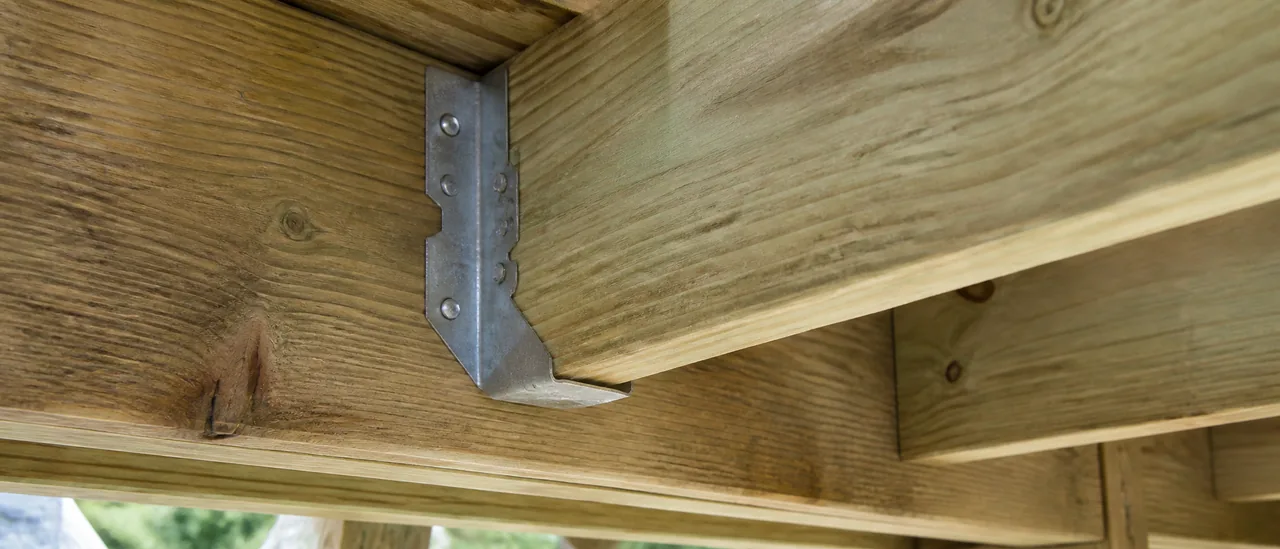
Missing joist hangers usually means the inspector saw one or more joist ends without the metal connectors expected at that connection. A joist hanger supports a joist where its end meets the face of a ledger, beam, or header. If that joint relies on a hanger, its absence can interrupt the intended load path and deserves correction or further evaluation.
The finding does not automatically mean the floor or deck is failing. Some joists bear on top of a wall or dropped beam instead of hanging from its side. Other older or engineered assemblies may use a ledger strip or another connection detail. The real question is whether the observed joist has adequate support for that specific assembly.
“No hanger” is not the whole diagnosis
Fairfax County’s deck details illustrate the key distinction: joists bear above a dropped beam, while joists meeting the side of a flush beam use hangers. That example is not a universal code ruling, but it shows why the surrounding connection matters.
What may have caused the finding
The hangers may have been omitted during original construction or during a later repair, addition, deck alteration, or framing change. Sometimes hardware is present but incomplete: a hanger may be undersized, bent, corroded, detached, or missing specified fasteners. Those are different observations, yet each can weaken a connection that depends on the hanger.
A look-alike is also possible. Blocking, a rim joist, or a joist sitting directly on a supporting member may not need the same hardware as a joist terminating against a beam’s face. Photographs should therefore show the joist end, its support, nearby connections, and any displacement—not just an empty patch of wood.
What the inspection can confirm
A standard home inspection can document visible, accessible framing and structural components. The inspector may identify absent hardware, separation, rotation, sagging, damaged wood, corrosion, or an inconsistent connection pattern. Comparing nearby joists can help explain the observation, but repetition alone does not prove the detail is adequate.
The inspection generally cannot expose concealed fasteners, calculate connection capacity, establish code compliance, or provide an engineering conclusion. InterNACHI’s standard specifically excludes determining the adequacy of joists or support systems and providing engineering services. Finished ceilings, insulation, tight crawl spaces, and deck skirting may further limit the view.
How urgent is it?
Treat a missing hanger as a repair concern when a joist visibly terminates at the side of its support with no other clear bearing detail. Prompt evaluation is more important when several connections are affected or when there is movement, splitting, decay, corrosion, or noticeable deflection. Avoid heavily loading an area that appears unstable.
If the report only says “missing hangers,” ask which joists are involved, how they are supported, and whether access limited the conclusion. A qualified framing contractor can evaluate a straightforward connection. A structural engineer is appropriate when the load path is unclear, movement is present, or a structural conclusion is needed.