On this page
The inspector could not find local controls for the washer supply
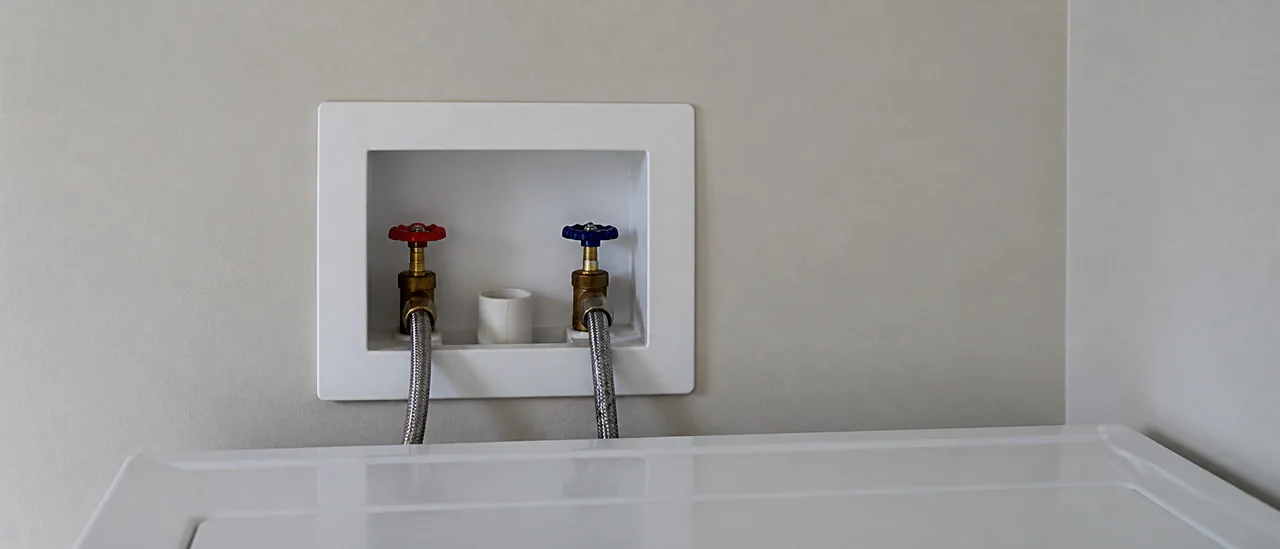
Missing laundry shutoff valves usually means the inspector saw washing-machine water connections but found no accessible hot- and cold-water controls nearby. The finding does not, by itself, prove a leak or concealed plumbing defect. It means there is no obvious local way to isolate those supplies for service or a water emergency.
The whole-house main valve may still stop the water. That is less convenient and affects more than the laundry connection. A local supply valve is intended to shut off water to a specific appliance, according to municipal water-utility guidance.
Other explanations are possible
“Missing” sometimes describes what was visible, not the entire piping layout. The report and photographs may point to one of several conditions:
- the valves were never installed at an unfinished or altered laundry rough-in;
- they are behind the washer, cabinetry, stored belongings, or a covered outlet box;
- a labeled remote manifold or branch valve controls the laundry supplies elsewhere; or
- valve bodies are present, but handles are absent, damaged, or unreachable.
These situations have different repair implications. A hidden but accessible, correctly identified control is not the same as no control at all. Conversely, an exposed hose connection without any known isolation point deserves clarification before the washer is used or disconnected.
“Missing” is an observation, not a code ruling
Plumbing requirements depend on the location, adopted code edition, building type, and installation history. A home-inspection note alone does not establish when the work was installed or whether a particular code applies.
Confirmation goes beyond a normal visual inspection
Start with the report photos and ask which connections were visible or inaccessible. An inspector may trace exposed piping and note nearby labeled controls, but normally will not move a heavy washer, open finished walls, or operate shutoff valves merely to prove where the lines terminate.
That limitation matters. The current InterNACHI standard defines an inspection as a visual examination of accessible areas, yet specifically says inspectors are not required to inspect clothes-washing machines or their connections. It also does not require them to operate valves. The inspection agreement or applicable state standard may set a different scope.
A qualified plumber can trace the supplies, identify any remote control, assess accessibility and condition, and determine whether changes are appropriate under local requirements.
Match the response to the evidence
If the area is dry, the hoses are not connected, and no damage is reported, this is generally a planning item rather than proof of an active emergency. Confirm the arrangement before installing or servicing a washer.
Prompt attention is more appropriate when a washer is connected and no one can identify how to isolate it. Active dripping, damp finishes, corrosion, or staining raises the urgency: stop the water using a known safe control if necessary and arrange qualified evaluation. The visible evidence—not the words “missing valves” alone—should determine the priority.