On this page
What the finding most likely means
Rotted support beams usually mean moisture has allowed wood-decay fungi to damage part of a load-carrying member. The finding matters because decay can reduce wood strength, but it does not prove that the beam is failing or that the whole structure is unsafe.
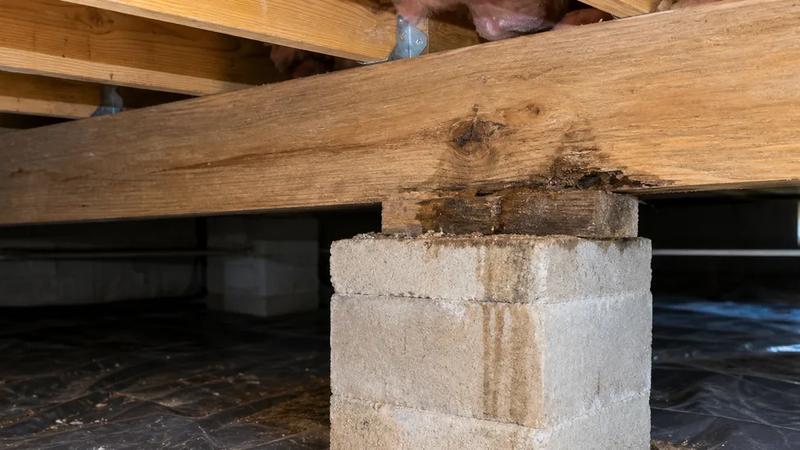
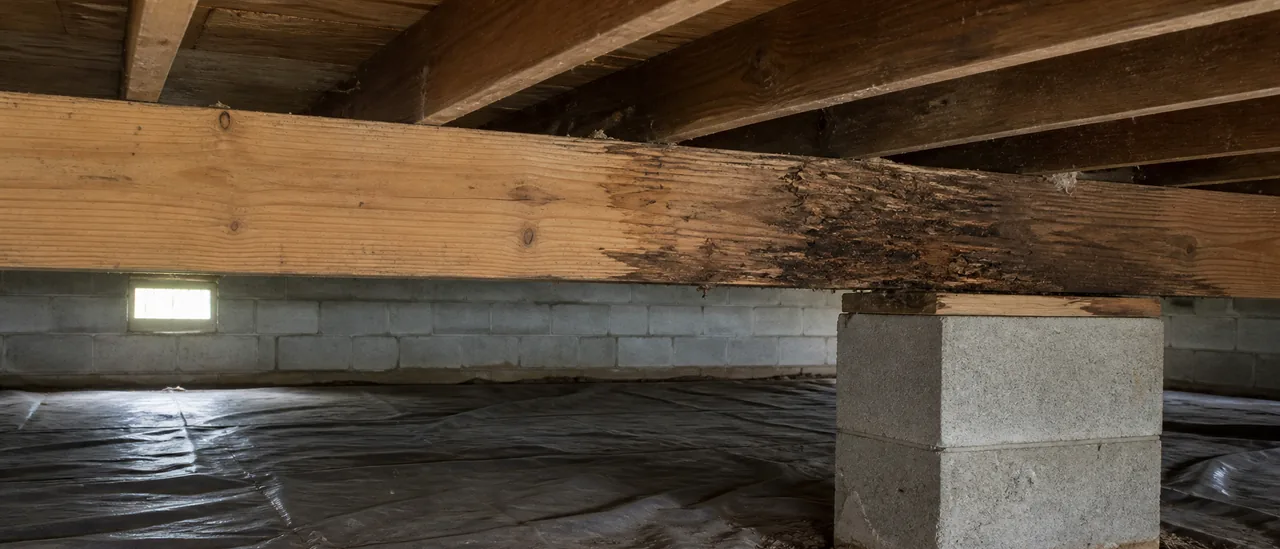
“Support beam” is often a plain-language label for a beam or girder supporting floor framing. The report’s photos and location should identify the actual component. “Rotted” may describe visible softening, crumbling, fiber loss, or fungal growth; staining alone is not enough to establish decay.
USDA Forest Products Laboratory research notes that decay can make wood structurally unsound before the damage becomes visually apparent. Severity therefore depends on where the damage is, how deeply it extends, and how much sound wood remains—not simply whether a dark area is visible.
Why a beam may deteriorate
Decay points to a moisture history, so the source matters as much as the damaged wood. Common possibilities include:
- a plumbing or appliance leak above the framing;
- rain or groundwater entering near the foundation;
- condensation or persistently damp crawlspace air;
- wood touching damp soil or masonry; or
- an older leak that has stopped but left damaged wood behind.
University of Minnesota Extension identifies rain or groundwater, indoor moisture, and humid outdoor air that condenses on cooler basement surfaces as major moisture sources. A dry reading on inspection day cannot, by itself, show whether the wood stayed dry in the past.
What a home inspection can confirm
A home inspector can document accessible surface conditions, moisture clues, sagging, splitting, altered framing, and deterioration around bearing points or connections. Gentle probing may help distinguish sound wood from soft surface decay where it can be done without damage.
Visual inspection cannot reliably define hidden or early-stage decay. USDA guidance says visible inspection is useful for intermediate or advanced surface decay, while affected areas require further investigation to define the damage. Finished ceilings, insulation, stored items, and inaccessible crawlspaces can also block the relevant view.
InterNACHI’s Standards of Practice describe a home inspection as a non-invasive, visual examination of accessible areas and require inspectors to examine structural components. They do not require engineering services, a report on structural adequacy, or a determination of every cause. State rules and the inspection agreement may differ.
Urgency and the practical next step
Treat visible loss of support as prompt, not routine
Keep people and concentrated loads away from the area if the beam is crushed, badly sagging, separating at a support, or actively shedding wood. Prompt structural evaluation is appropriate when visible deterioration affects a bearing point, spans a substantial area, or accompanies floor movement.
Less extensive surface damage may not be an emergency, but it still needs a defined moisture source and confirmed extent. A qualified wood-damage specialist can help identify decay and moisture conditions; a structural engineer should determine load capacity and repair needs when structural conclusions are required.