On this page
What roots usually mean
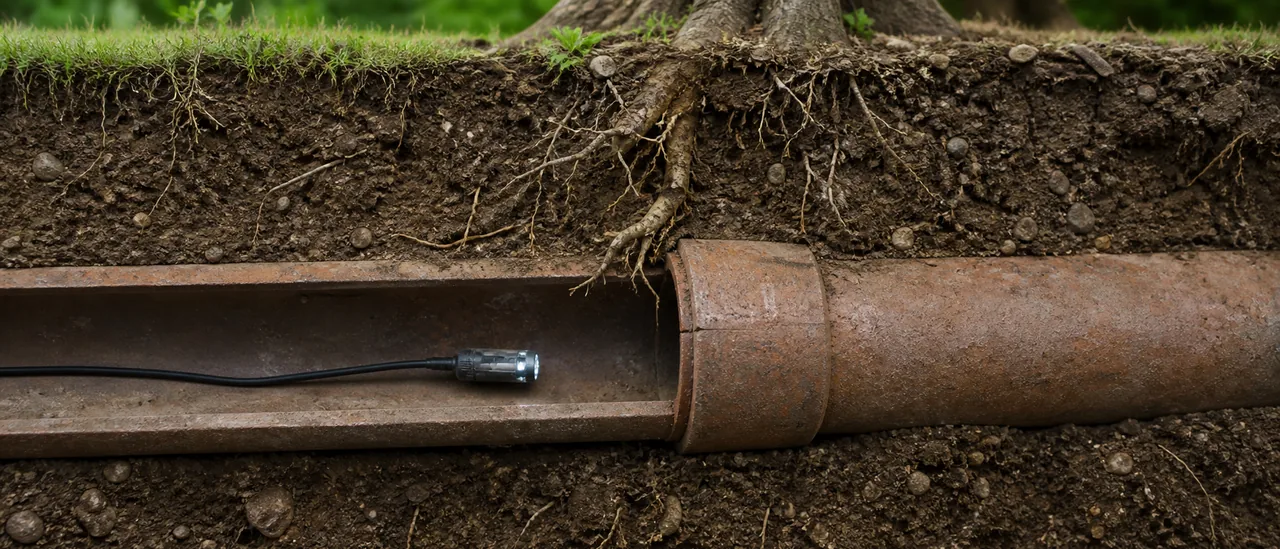
Tree roots visible inside a sewer line usually mean they entered through an existing opening. That opening may be a crack, gap, or unsealed or separated joint. Roots alone do not prove that the entire pipe has collapsed, but they do indicate a pathway that should not be dismissed.
The U.S. Environmental Protection Agency identifies tree roots entering through sewer defects or openings as a possible cause of blockages. The practical concern depends on what the camera shows around them. Sparse strands with an otherwise open pipe are different from a dense mass accompanied by restricted flow, standing water, displacement, or broken pipe.
Roots are a finding, not a complete diagnosis
A root mass can hide the exact entry point. The video may establish intrusion without showing whether the underlying opening is a loose joint, crack, or more extensive deterioration.
How the finding is confirmed
A standard home inspection does not normally include a view inside the buried sewer lateral. The American Society of Home Inspectors describes a sewer lateral scan as an additional service because specialized camera equipment is needed.
When that service is performed, a waterproof camera travels through the lateral from an available access point. The resulting video can show visible roots and related conditions such as cracks, offsets, standing water, restrictions, or a broken section. InterNACHI's sewer-scope standard calls for reporting any observed plant or tree root intrusion as needing correction.
Fixture operation cannot provide the same confirmation. A toilet that flushes and sinks that drain only show performance during the inspection. Conversely, slow drainage or a backup can justify investigation, but those symptoms do not identify roots as the cause without seeing the line.
What the camera cannot settle
Even a sewer scope is not technically exhaustive. Access may be unavailable, debris or water may obscure the view, and the camera may not pass a restriction. The report should identify which portion was viewed and where the inspection stopped.
The footage also does not predict when a blockage will occur or, when roots obscure the pipe wall, establish the full repair scope. Cutting roots may reopen the flow path, but it does not by itself close the opening that allowed entry.
Urgency and the practical next step
Root intrusion deserves timely evaluation, but the video determines whether the situation appears immediately disruptive. Restricted flow, widespread roots, sewage backup, a broken or collapsed section, or substantial standing water raises urgency. A small visible intrusion without drainage symptoms may allow more orderly planning, but it still represents an entry point that can grow or collect material.
Have a qualified sewer or plumbing specialist review the complete recording when roots are reported, especially if the camera could not pass or the pipe condition remained hidden. The goal is to distinguish cleaning from a repair that addresses the entry point—not to assume every root finding requires full line replacement.