On this page
What the finding usually means
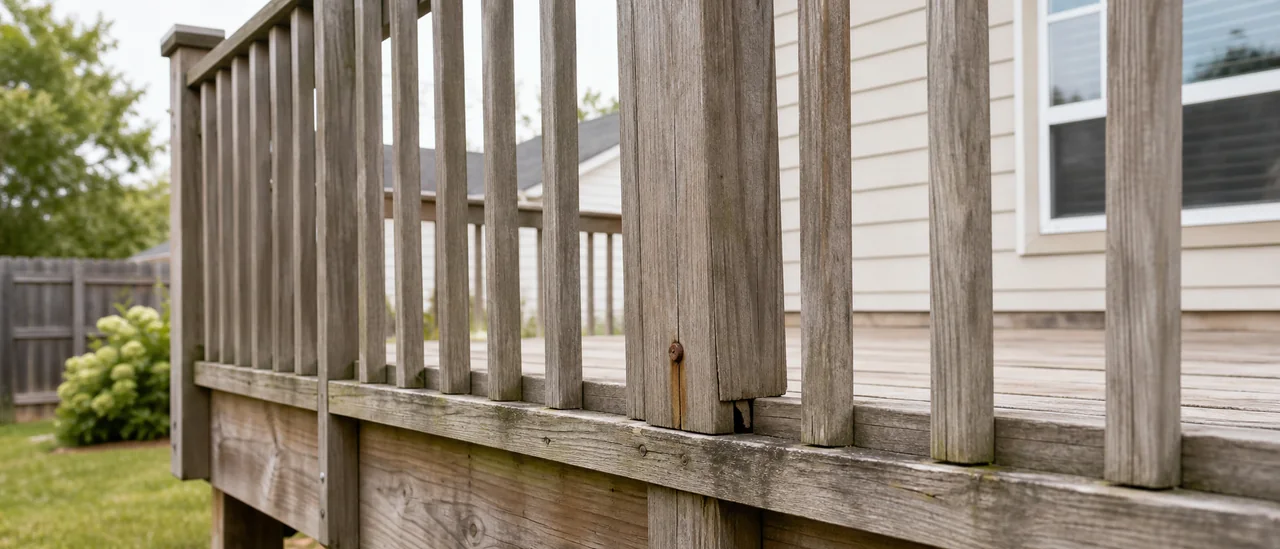
Unsafe deck railings usually mean the inspector saw a visible condition that may not provide reliable fall protection. The concern may be serious, such as a loose guard post, missing section, damaged rail, or deteriorated connection. It may instead involve one limited detail, such as an opening between balusters that the inspector considers improper.
“Unsafe” is a professional judgment about the observed condition, not proof that the entire deck will fail. It also is not automatically a code-violation determination. Under the ASHI general standard, inspectors report inspected components they judge unsafe, while code compliance and the causes of deficiencies are outside the required determination.
Why railings receive this comment
The visible clue should be stated in the report. Common concerns include movement at posts or rails, missing or broken infill, open ends, decay, split wood, corrosion, loose fasteners, and dimensions or openings that may not match the applicable requirement.
Surface weathering, peeling finish, or a minor crack may look troubling without reducing the railing’s function. Conversely, a sound-looking top rail can conceal weak attachment details. Age alone does not decide whether the railing is safe.
Guard, railing, and handrail are not always interchangeable
A guard helps prevent a fall from an elevated walking surface. A handrail provides a graspable surface along stairs. An inspection comment should identify the affected part, because the hazard and correction can differ.
What the inspection can confirm
ASHI’s general standard includes attached and adjacent decks and their railings. Its separate deck-inspection standard calls for examining visible guards, stair guards, handrails, support posts, infill, fasteners, and connectors. Both standards are visual and limited to readily accessible components.
An inspector can document movement, damage, missing parts, visible deterioration, and questionable spacing. A normal home inspection cannot confirm concealed fastener length, hidden rot, internal corrosion, or the capacity of an assembly. The ASHI deck standard excludes concealed components and does not require architectural or engineering services.
Urgency and the practical next step
Treat obvious looseness, a missing section, severe deterioration, or an open elevated edge as a fall hazard. Keep people away from the affected deck or stair area until it is evaluated.
For a less specific comment, ask for the exact location, photograph, and observed defect. A qualified deck professional or structural specialist, as appropriate, can examine connections and concealed-risk areas and compare the installation with manufacturer instructions and locally adopted requirements. The local building department can clarify which code applies; the original construction date and later alterations may matter.
Do not test a questionable railing with body weight
Pushing or leaning hard against a visibly loose guard can trigger the failure the railing is supposed to prevent. Restrict access and arrange evaluation before normal use.