On this page
A roof test cut is a small, destructive sample
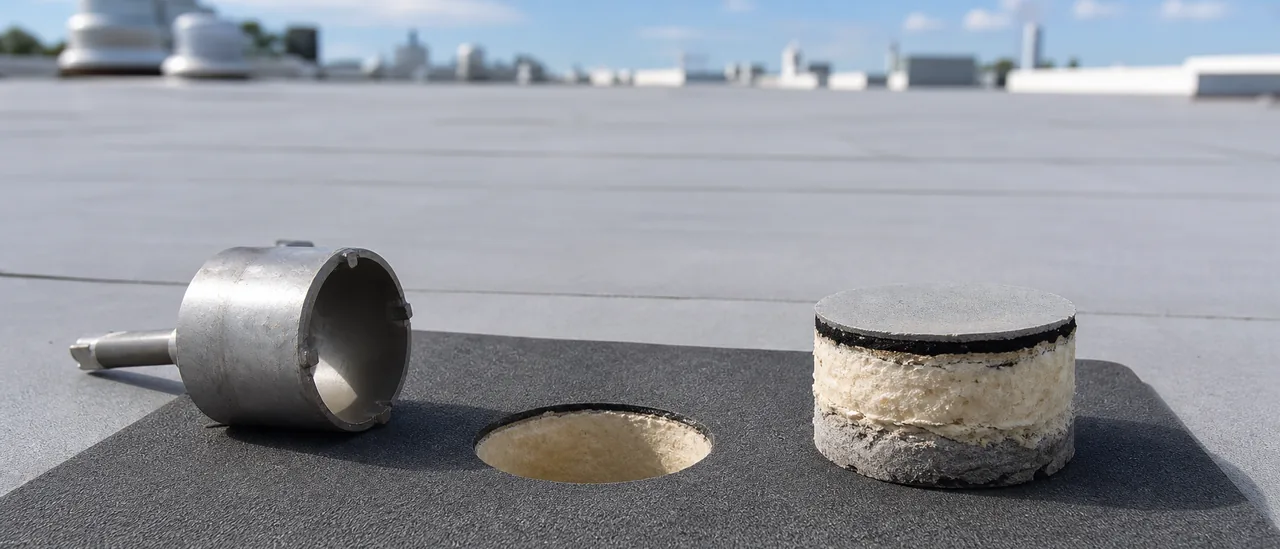
A roof test cut is an opening made through part or all of a roof assembly so its layers can be examined directly. Depending on the method and roof system, the removed specimen may be square, rectangular, or a smaller round core. People sometimes use test cut, roof cut, and core sample loosely, although the specimen and analysis can differ.
The opening can show the membrane and insulation layers present at that location. It may also reveal visible moisture, voids, poor bonding, or deterioration that surface observations cannot establish. This matters when a decision depends on what is hidden below the exposed membrane.
When is a roof test cut appropriate?
A test cut is most useful when the needed fact cannot be confirmed from records, visual inspection, or a non-destructive survey. Common reasons include:
- identifying an undocumented existing assembly before reroofing work;
- checking a selected area where leakage or trapped moisture is suspected;
- confirming what a thermal or electronic moisture survey indicates at a specific point; or
- evaluating an observed installation problem when a project specification calls for sampling.
The method should match the question. ASTM D2829/D2829M addresses specimens from existing built-up roofs and determination of their approximate components. ASTM D3617/D3617M applies to built-up bituminous systems during installation, before flood coating and top surfacing. Neither standard is a universal procedure for every membrane or steep-slope roof.
One cut is evidence about one location
A dry or sound specimen does not prove the entire roof is dry or sound. Sampling locations and quantity should follow the investigation goal, roof history, survey findings, and applicable roof-system guidance.
What a test cut cannot decide by itself
A test cut does not map the full extent of a concealed condition. It also does not, by itself, determine a roof’s remaining service life or establish why moisture entered. Those conclusions require the sample to be considered with drainage, flashings, leak history, plans, surface conditions, and any broader survey data.
The procedure also creates a new opening in the weather barrier. The roof owner should authorize it, and a qualified roofing professional should choose the location, document the layers and conditions, then restore the area with materials and methods compatible with that roof. Existing warranty requirements should be checked before cutting.
Practical bottom line
Use a roof test cut when a consequential decision depends on concealed assembly facts that less-invasive methods cannot answer. Define the question first, select representative locations deliberately, and treat each result as a local finding—not a verdict on the whole roof.