On this page
What an infrared roof inspection is
An infrared roof inspection is a nondestructive survey that maps temperature differences across a roof surface. Those thermal patterns can reveal areas where the roof assembly behaves differently, including locations that may contain moisture-damaged insulation.
It matters because trapped moisture is usually hidden below the membrane. Infrared imaging helps an inspector narrow a large roof to specific areas for closer testing, but the camera does not directly photograph water or diagnose a leak.
How infrared roof scanning works
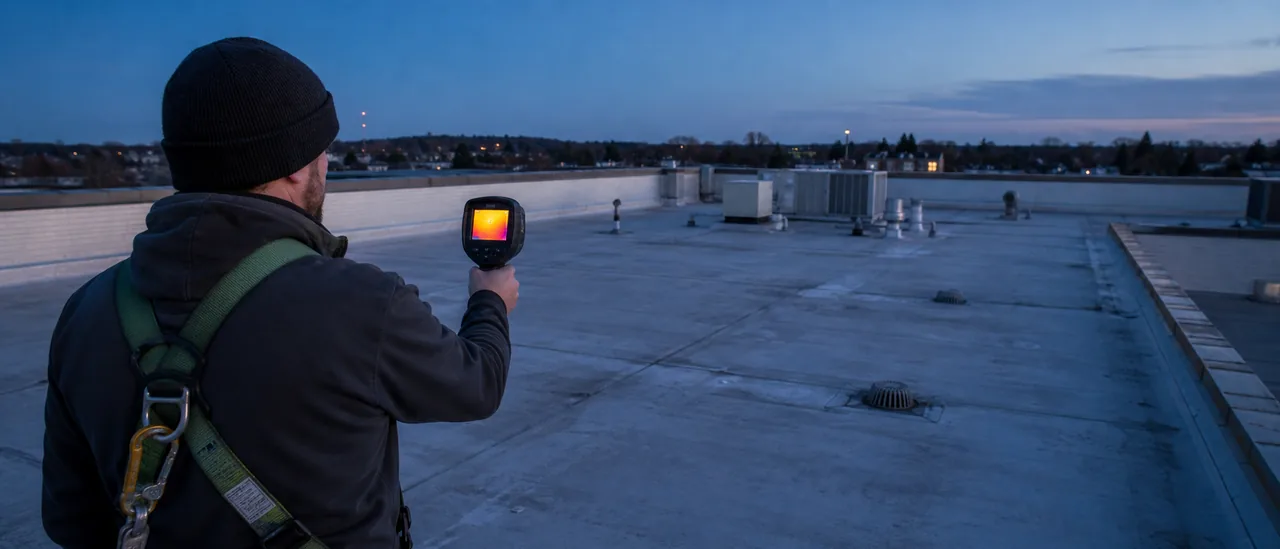
Roof materials absorb, store, and release heat at different rates. During a typical scan, the roof receives heat from sunlight or the building interior. After sunset, dry and moisture-affected areas may cool at different rates because their thermal properties differ.
An inspector walks the roof with a handheld imager or surveys it from above using aerial equipment, including an infrared-capable drone. The camera records emitted infrared energy and displays relative surface-temperature patterns. The inspector then compares anomalies with visible conditions, roof construction, drainage features, repairs, and rooftop equipment.
ASTM C1153-23 covers nighttime ground-based and aerial infrared inspections for roofing systems with insulation above the deck and in contact with the waterproofing. It also addresses equipment, weather, construction effects, operator practices, and invasive verification.
A thermal anomaly is evidence to investigate
A warm or cool pattern is not proof of wet insulation. Confirmation may require a moisture probe, core sample, or another suitable test at representative locations.
Conditions and limitations
Useful results depend on a measurable temperature contrast. Sun exposure, indoor-outdoor temperature difference, recent temperature change, wind, cloud cover, and surface moisture can strengthen or obscure a pattern. Roof coverings that store heat can also mask the assembly below.
Construction matters, too. Ballast, reflective surfaces, patches, ponding water, varying insulation thickness, and heat-producing equipment can create patterns unrelated to trapped moisture. Some roof assemblies therefore produce weak or ambiguous scans even when the equipment works properly.
The method answers a limited question: where does the roof show a thermal pattern consistent with a condition worth testing? ASTM C1153 does not determine how moisture entered, locate the precise leak path, or establish whether the roof remains suitable as waterproofing.
Practical bottom line
An infrared inspection is best understood as a screening and mapping tool. It can guide targeted verification and reduce unnecessary exploratory openings, but it cannot replace visual inspection, knowledge of the roof assembly, or confirmation testing.
If the findings will support repair or replacement decisions, have a qualified roof professional interpret the images and document how suspect areas were verified.