On this page
Use it after simpler methods leave a material question
Destructive roof testing is usually necessary only after records, visual inspection, and suitable nondestructive methods cannot answer a decision-critical question. Arrange targeted testing promptly when active leakage, suspected trapped moisture, an unknown roof assembly, or possible deck deterioration could change the repair or recover plan.
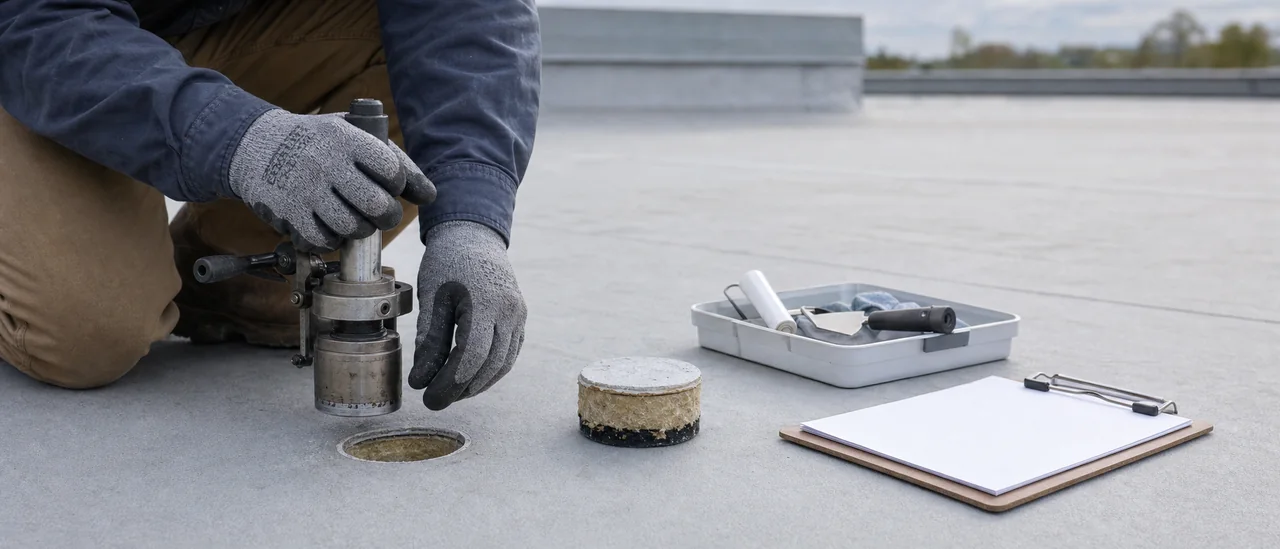
The term generally means deliberately opening or penetrating a limited roof area. A core sample or test cut can expose membrane plies, insulation, attachment, and the deck. The opening must then be repaired; testing is not merely a closer visual inspection.
When an opening earns its place
The clearest reasons are to:
- identify concealed layers, materials, thicknesses, or attachment when reliable records are unavailable;
- confirm whether a moisture-survey anomaly represents wet roofing materials;
- compare a suspected wet location with an apparently dry control location;
- examine a concealed substrate or deck when deterioration is suspected; or
- obtain a representative specimen for analysis under a procedure suited to that roof system.
This sequence matters. Infrared, electrical-impedance, and nuclear surveys can screen a much larger roof without making hundreds of holes. They locate patterns or comparative anomalies, but they do not directly expose every layer. IIBEC’s guidance for reusing insulation in low-slope roof recover projects says nondestructive findings require confirmation with extracted roof cores.
A core confirms its location—not the entire roof
Sampling is selective. The test plan should explain why each location was chosen, what question it answers, and how far the result can reasonably be applied.
Important limits and exceptions
The method must match the roof and the question. ASTM D2829/D2829M, for example, covers specimens removed from existing built-up roofing systems to determine their components. It is not a universal sampling procedure for every membrane, metal roof, shingle roof, or sprayed-foam assembly.
Destructive work also creates a new opening in the weather barrier. ASTM’s guide for low-slope leak investigations says an investigator should anticipate destructive procedures and plan necessary repairs and selective reconstruction. Permission, safe access, weather, sample locations, repair materials, and any applicable warranty requirements therefore belong in the plan before cutting begins.
Testing may be unnecessary when the needed condition is already visible, reliable documents answer the assembly question, or the result would not change the decision. Conversely, widespread unsafe or unstable conditions may call for a structural or roofing specialist to define safe access before any roof cut.
Practical bottom line
Start with the least invasive method capable of answering the question. Move to a small, documented opening when concealed construction or moisture must be verified—not simply because more testing sounds thorough. A useful report records the location, roof layers, observed condition, sample handling, limitations, photographs, and completed patch.