On this page
Start with a time and place
Write down the exact location, date, approximate clock time, and time zone. Then search NOAA’s Storm Events Database for a hail event on that date, narrowing the results by state and county.
Open the closest matching event and compare its beginning and ending times. Subtract the start from the end for the recorded duration. Read the event narrative too; National Weather Service guidance says broad time estimates should be identified there.
Do not leave shelter to improve your notes during a storm. A severe thunderstorm warning calls for taking shelter in a substantial building.
Check what the timestamps represent
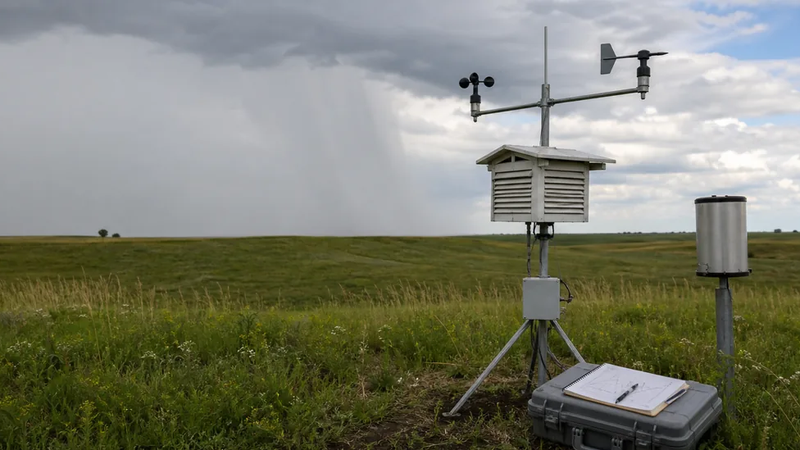
The database answer is an official event record, but it may not equal the minutes hail fell at one address. Hail events are collected by county, and the listed location or narrative may describe somewhere nearby. The National Weather Service also acknowledges that timing to the nearest minute can be difficult.
For a recent storm, look for Preliminary Local Storm Reports from the responsible NWS forecast office. These reports relay time-stamped hail observations from sources such as spotters, officials, media, and the public. Compare the first and last reports close to the location, but treat that span as a bracket of documented observations—not proof that hail fell continuously between them. Reports remain preliminary until certification into Storm Data.
Use radar to narrow the interval
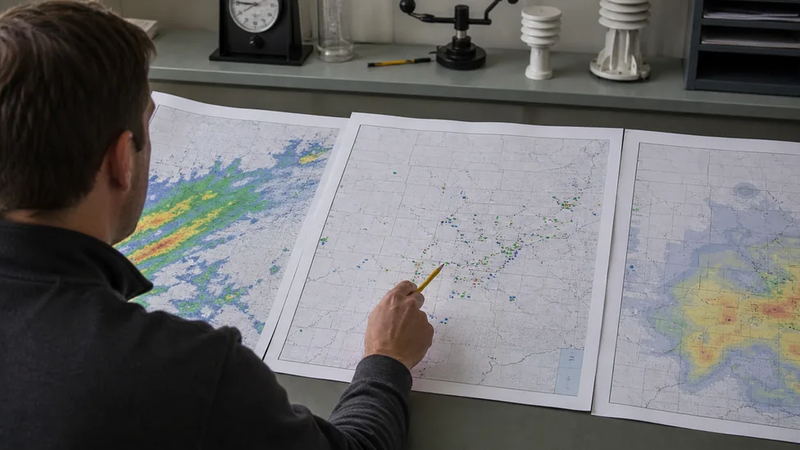
If reports are sparse, retrieve archived NEXRAD data from NOAA’s National Centers for Environmental Information. Select the nearest useful radar, display scans before and after the suspected period, and note the first and last scan showing a hail-related signature over the location.
Radar cannot usually provide second-by-second ground timing. NEXRAD base-data files typically represent four, five, six, or ten minutes, depending on the scanning pattern. Distance from the radar, beam height, storm motion, and gaps between scans add uncertainty.
Keep three conclusions separate
Radar-indicated hail is suggested, not confirmed. Observed hail comes from a reliable report or direct record. Neither establishes that hail damaged a particular property; confirmed damage requires separate evidence.
Choose the most defensible answer
State both the interval and its basis: for example, “observed reports bracket hail between 6:12 and 6:19 p.m.” or “radar suggests a roughly 10-minute window.” Time-stamped video from a safe indoor viewpoint can support a more exact address-level answer.
When a minute-level determination matters, ask a meteorologist or weather-data specialist to reconcile Storm Data, local reports, radar scans, and time zones. Otherwise, the most honest result is a documented range with its uncertainty clearly labeled.
Related reading: Where Does Hail Freeze?