On this page
Hail can fall from about 9 mph to more than 100 mph
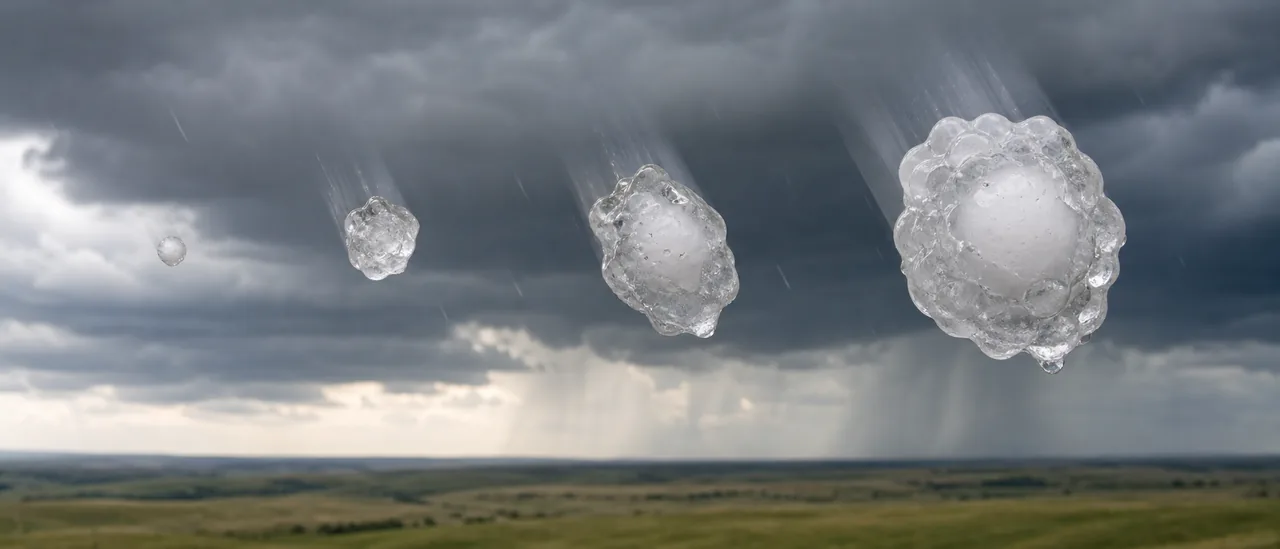
Small hailstones under 1 inch in diameter typically fall at about 9 to 25 mph. At the other extreme, exceptional stones wider than 4 inches can exceed 100 mph. Those are expected ranges, not a speed limit for every stone.
NOAA’s National Severe Storms Laboratory (NSSL) gives useful size-based benchmarks: 1- to 1.75-inch hail at 25 to 40 mph, and 2- to 4-inch hail at 44 to 72 mph. In this context, “fall speed” describes a hailstone’s downward motion during descent. It is not a radar reading of an individual stone.
| Hailstone diameter | Expected fall speed |
|---|---|
| Under 1 inch | 9–25 mph |
| 1–1.75 inches | 25–40 mph |
| 2–4 inches | 44–72 mph |
| Over 4 inches | Can exceed 100 mph |
Why size changes the answer
The published speed bands rise sharply with diameter, but size is not the only control. Real hail is not made of tidy laboratory spheres. NSSL reports that wind-tunnel casts of natural hailstones repeatedly fell more slowly than solid ice spheres.
NSSL identifies four main influences on fall speed: stone size, friction with the surrounding air, local horizontal and vertical winds, and melting. It also warns that shape, fall orientation, and environmental conditions create substantial uncertainty in the estimates.
A stone may shrink or change shape as it passes through warmer air. An updraft can reduce its downward speed relative to the ground, while a downdraft can increase it. Horizontal wind adds sideways motion, so a stone may approach the surface diagonally rather than straight down.
Three different kinds of evidence
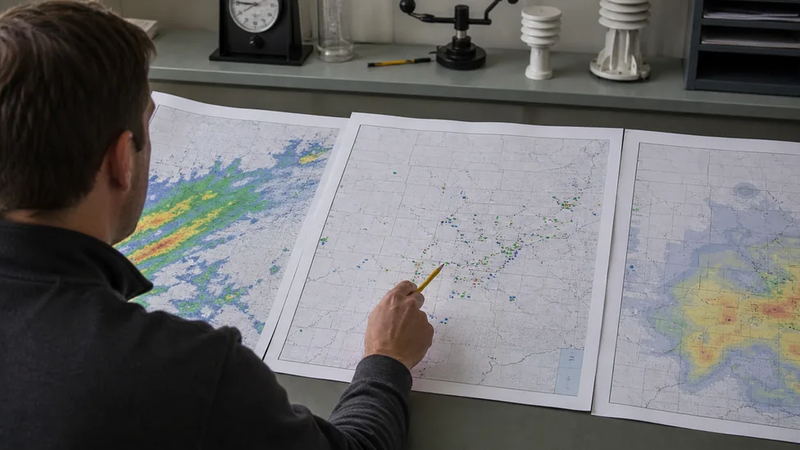
Radar estimate: MESH uses radar and atmospheric information to estimate maximum hail size in a storm. Observed hail: A stone measured or reliably reported at the surface documents hail at a particular place and time. Confirmed property damage: Physical damage is a separate observation; neither radar nor a hail report alone proves it occurred at a specific property.
The practical bottom line
Use 9 to 25 mph for small hail and more than 100 mph as possible for exceptional hail to understand the overall scale. Most answers between those endpoints depend first on diameter, then on the stone’s shape, melting, orientation, and the air moving around it.
The published figures are best treated as expected ranges with wide uncertainty. They explain how quickly hail may descend, but they cannot reconstruct the exact speed or path of one unmeasured hailstone.