On this page
A PVC roof inspection follows the membrane and every water-entry detail
A PVC roof is a single-ply roof made with flexible polyvinyl chloride membrane. An inspection systematically checks the exposed membrane, heat-welded seams, edges, flashings, penetrations, and drainage components. The goal is to locate defects or changes that could interrupt the roof’s continuous waterproof layer.
ASTM D4434/D4434M defines PVC roofing sheet but does not set criteria for evaluating an installed roof system. That distinction matters: an inspector must consider the roof’s specific design, attachment method, details, age, and service history rather than judging the membrane by appearance alone.
The inspection moves from broad conditions to close details
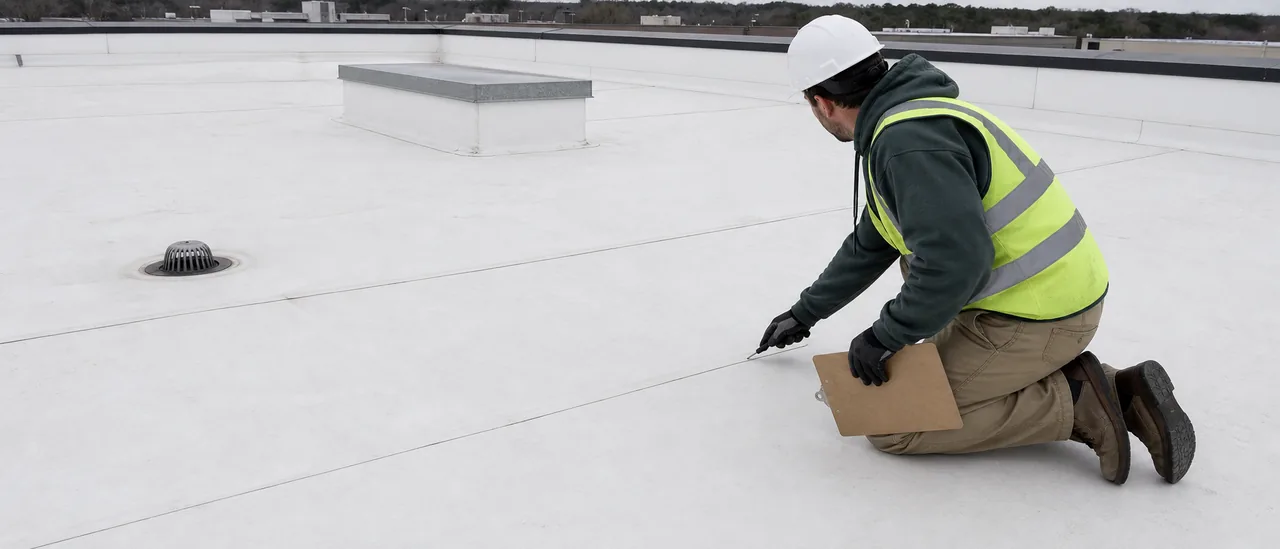
The inspector first reviews safe access and walks the roof in an organized pattern. The field membrane is checked for punctures, cuts, open laps, wrinkles, displaced components, contamination, and areas holding water or debris.
Attention then shifts to the places where the membrane changes direction or meets another component:
- welded field seams and intersections;
- perimeter edges and terminations;
- walls, curbs, and equipment supports;
- pipes and other penetrations; and
- drains and scuppers.
Carlisle’s published PVC checklist illustrates this sequence. Its final-installation process covers the perimeter, all roof-level seams, curbs, penetrations, drains, and then the overall system. The checklist is manufacturer-specific, but the progression shows why an inspection cannot be reduced to looking for holes in the open membrane.
Seam probing has a specific purpose
A trained inspector may carefully probe welded seam edges to find an opening or incomplete weld. Carlisle requires PVC seams to be probed before its final inspection; that requirement should not be treated as a universal maintenance procedure or permission to use sharp tools casually.
Findings need context
An opening at a seam or flashing is a direct defect. Discoloration, surface dirt, or a wrinkle may instead require comparison with installation details and the membrane manufacturer’s guidance. The inspector should document each condition with its location, extent, and photographs rather than infer performance from one image.
A surface inspection also has limits. It may identify likely entry points, but it cannot by itself establish whether insulation or decking below the membrane is wet, deteriorated, or structurally sound. If observations justify further investigation, a qualified reviewer can select appropriate non-destructive testing or limited openings.
The practical bottom line is a methodical, detail-by-detail examination—not a quick rooftop glance. The most useful report separates observed defects from suspected concealed conditions and states where additional investigation is needed.