On this page
Typical microwave repair cost in 2026
As of August 2026, a professional microwave repair typically costs $100 to $200, with a national average near $150 to $175. That range generally covers parts and labor for a straightforward repair. The failed component, microwave type and accessibility, and local labor rates change the price most.
A small repair may cost about $50 to $100, while a difficult built-in repair or major component replacement can reach $300 to $500. “Does not work” can mean no power, no heat, an unresponsive control panel, or a turntable that will not move. Those symptoms do not identify the failed part, so the price remains a planning range until diagnosis.
Cost by likely repair scope
| Scenario | 2026 planning range | What it may involve |
|---|---|---|
| Low | $50–$100 | Accessible fuse, door switch, or similarly small repair |
| Typical | $100–$200 | Common component repair with ordinary parts and labor |
| High | $300–$500 | Costly control, door, or hard-to-access built-in work |
These ranges apply to repairing the microwave itself. They do not include replacing the appliance, modifying cabinetry, repairing an unsuitable outlet, or correcting a separate ventilation problem.
What an estimate may include
A repair estimate may combine diagnosis, the replacement part, labor, reassembly, and an operational check. Some companies instead charge a $50 to $100 service-call fee and then quote the repair. Ask whether that fee is separate or credited toward approved work.
The estimate should name the suspected component and distinguish parts from labor. It should also state whether removal and reinstallation of an over-the-range or built-in unit are included. A second trip for a special-order part, disposal, after-hours service, or unrelated electrical work may be extra.
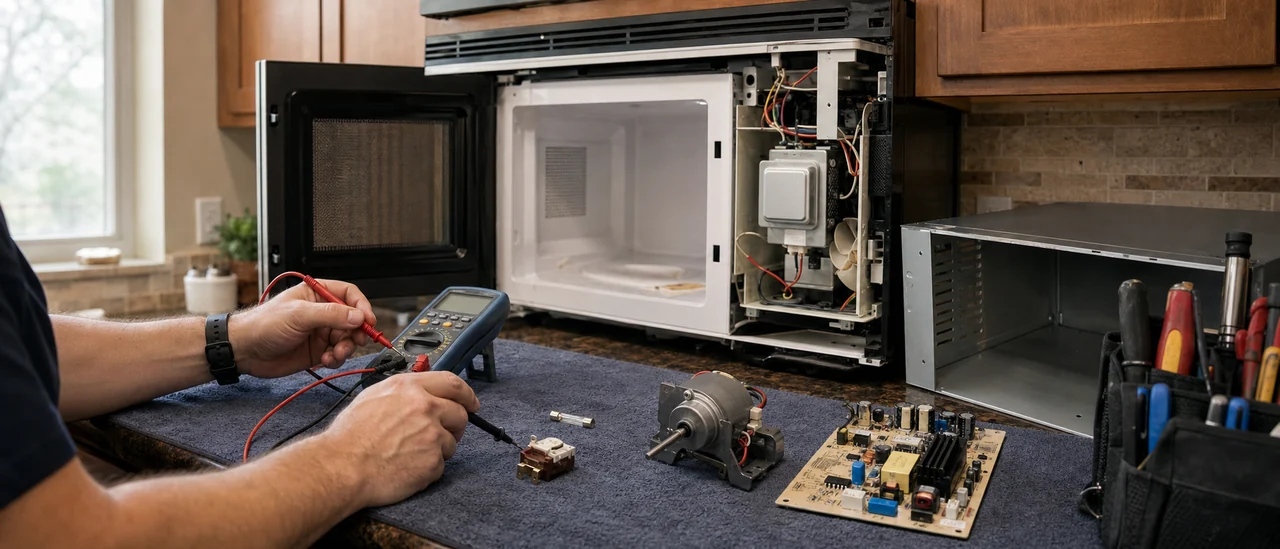
Internal microwave repair is not a routine DIY project
The U.S. Consumer Product Safety Commission warns that electrical shock remains possible after a microwave is unplugged. Do not remove the cabinet to investigate internal high-voltage components; use a qualified appliance technician for internal diagnosis.
Why the price changes
The failed part: A switch or fuse is usually toward the low end. A control board, door assembly, magnetron, or several failed components can add both parts cost and diagnostic time. Similar symptoms can have different causes, which limits the value of pricing by symptom alone.
Installation and access: A countertop microwave is generally easier to reach. Built-in and over-the-range units may need careful removal before internal parts are accessible, increasing labor even when the part itself is inexpensive.
Location and availability: Hourly rates, travel charges, and minimum service fees vary by region. Model-specific parts may also be harder to obtain, leading to higher prices or a return visit.
Warranty and quote structure: Coverage may reduce the part or labor charge, but terms differ. A low diagnostic price is not necessarily the full repair price, especially when removal, parts, or a second visit are excluded.
When to obtain a specialist estimate
Obtain a written appliance-repair estimate when the microwave has no power, will not heat, repeatedly trips a breaker, sparks, smells burned, or has a damaged door. Stop using it if there are sparks, smoke, a burning odor, visible door damage, or repeated breaker trips.
For a useful comparison, provide the model number and installation type, then ask each technician to identify the diagnostic fee, part, labor, removal, return-trip, and warranty charges. If the quote approaches the cost of another suitable unit, compare the complete repair total with replacement before authorizing work.