On this page
Typical cost in 2026
As of August 2026, fixing condensate pump failure typically costs $100 to $500 for professional diagnosis and a straightforward residential pump replacement. Pump style, equipment access, and any required drain-line or electrical work change the price most. A service visit that finds only a clogged condensate line may cost $75 to $300 instead.
Those figures are national planning ranges, not quotes. Current market guides list condensate pump replacement at $100 to $450 for a heat-pump system and $100 to $500 for an air-conditioning system. A difficult installation can exceed the range when the pump is concealed, built into compact equipment, or only one part of a larger drainage problem.
What “fixing the failure” includes
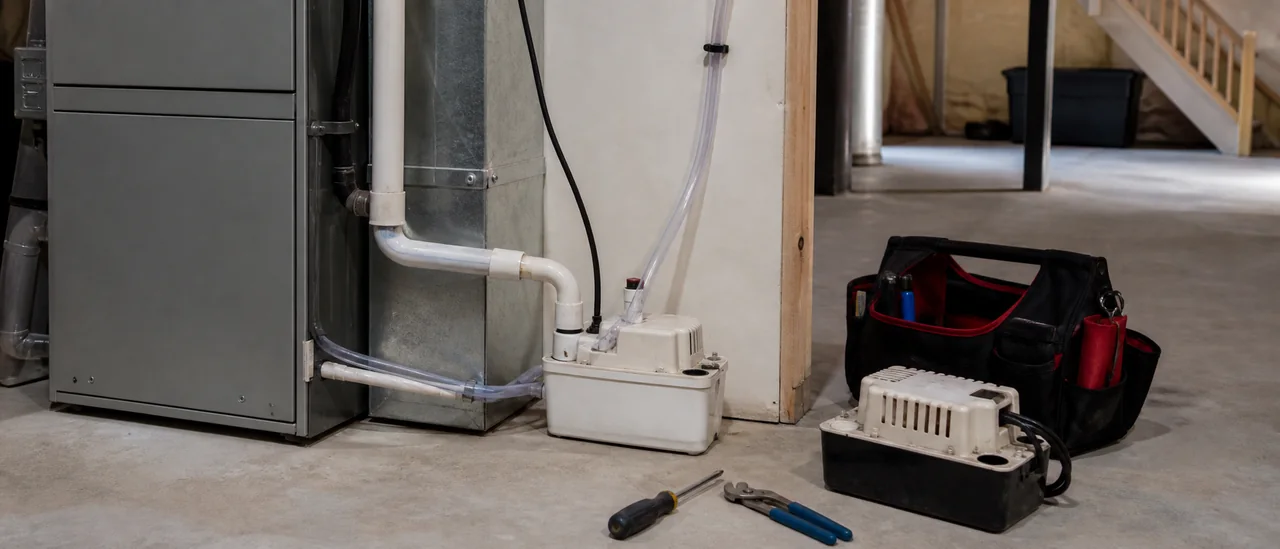
A condensate pump collects water produced by HVAC equipment and lifts it to a suitable drain when gravity drainage is unavailable. “Failure” means the installed pump is not reliably moving that water. It does not automatically mean the furnace, air conditioner, heat pump, or water-damaged finishes need replacement.
The usual estimate covers a service call, diagnosis, removal of the failed pump, a compatible replacement, ordinary fittings, reconnection, and an operating test. Confirm whether the quote also includes cleaning the reservoir and discharge tubing, testing the overflow shutoff, disposal, and a return visit.
| Scenario | 2026 planning cost | Likely scope |
|---|---|---|
| Low | $75–$250 | Diagnosis or accessible drain cleaning; no pump replacement |
| Typical | $100–$500 | Standard residential pump replacement and testing |
| High | $500+ | Difficult access, compact pump, added tubing, controls, or wiring |
The ranges overlap because minimum service charges can make a quick repair cost as much as an inexpensive replacement. Conversely, the pump itself may be only one line on a quote that also corrects the route carrying water away.
Main cost drivers
Access and configuration: A freestanding pump beside accessible equipment is generally simpler to replace than a compact pump inside a wall-mounted unit or equipment in a tight attic or crawlspace. More disassembly and testing mean more labor.
Drainage scope: A blocked tube may need cleaning rather than a new pump. Damaged tubing, an unsuitable discharge point, poor slope before the reservoir, or a longer lift to the drain expands the job beyond a basic swap.
Electrical and safety controls: Some installations connect the pump’s high-water switch to the HVAC controls so the equipment stops before an overflow. Correcting absent or damaged control wiring adds labor and should be identified separately on the estimate.
Local pricing and timing: Labor rates, travel distance, minimum charges, and after-hours service vary by market. Permit requirements are usually more relevant when the work changes drainage or electrical connections than when it replaces an accessible pump in kind.
Make sure the quote addresses the cause
Ask the evaluator to separate pump replacement from drain cleaning, tubing changes, control wiring, and moisture repairs. This prevents a low pump price from obscuring a larger drainage problem—and keeps unrelated damage from inflating the pump estimate.
When to obtain a specialist estimate
Obtain an HVAC evaluation when the pump does not run, runs without moving water, repeatedly triggers a shutoff, or overflows. Inspection guidance specifically calls for examining the condensate pump and its overflow shutoff capability; a successful motor sound alone does not prove the drainage system works.
Compare written estimates when the diagnosis is uncertain or the total exceeds the straightforward replacement range. Each should identify the failed component, pump configuration, discharge route, safety-control test, exclusions, and whether the service-call charge is included. Visible water near energized equipment warrants prompt evaluation without touching wet electrical components.