On this page
Bathroom exhaust fan repair costs in 2026
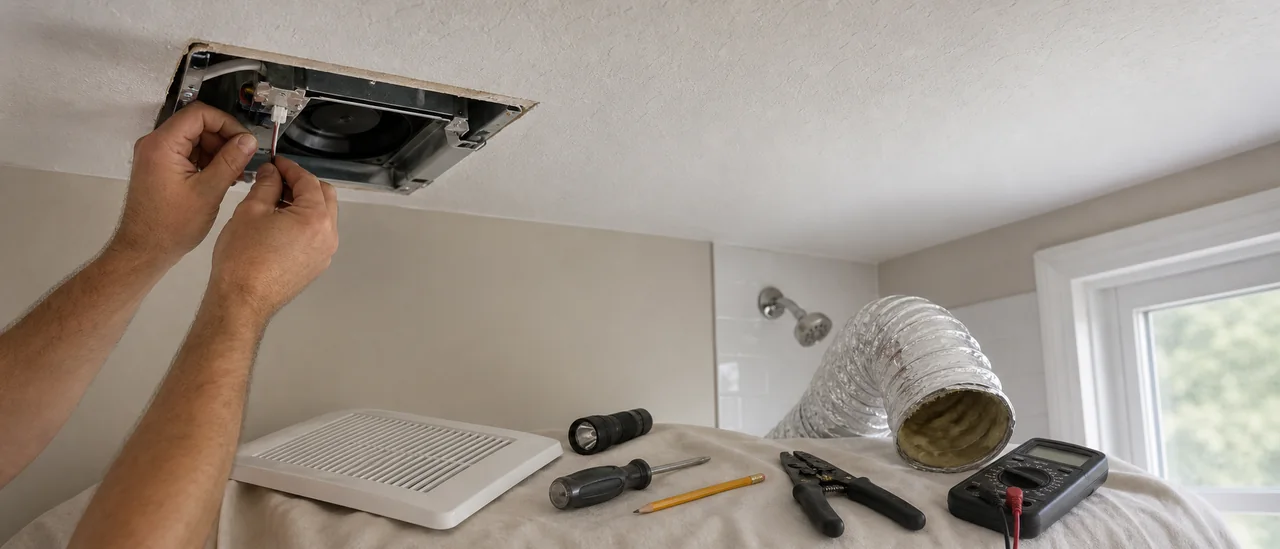
As of August 2026, budget about $250–$500 for an ordinary professional fix that ends in bathroom exhaust fan replacement. That planning range generally covers a moderate installation where the existing wiring, duct, opening, and exterior outlet remain usable.
Cleaning a dusty grille or blower can cost little beyond supplies. A new duct route, wiring correction, difficult ceiling access, or drywall and exterior work can push the total above $500. The diagnosis, access, and amount of connected-system work change the price most.
A June 2026 specialist guide places a moderate bathroom fan installation at $250–$500, depending on the fan selected, with an estimated two to four hours of work. These are national planning figures, not a local bid or a promise that connected-system repairs are included.
Low, typical, and high scenarios
| Scenario | 2026 planning amount | Likely scope |
|---|---|---|
| Low | Under $250 | Cleaning, securing a loose grille or housing, or another limited correction without replacement |
| Typical | $250–$500 | Like-for-like fan replacement using serviceable wiring, ductwork, opening, and exterior termination |
| High | More than $500 | New wiring or controls, duct replacement or rerouting, difficult access, exterior penetration, or finish repair |
The low and high rows are scope markers rather than quoted national ranges. A technician must identify whether the problem is in the fan assembly, its power or control, the duct, or the exterior damper before assigning a reliable price.
What a useful estimate includes
The estimate should identify the suspected fault and distinguish cleaning or repair from full replacement. It should list the fan, ordinary mounting hardware, labor, removal, disposal, and operational testing. Ask whether electrical diagnosis, permits, attic access, duct sealing, an exterior cap, and ceiling patching are included or excluded.
Fan performance can suffer even when the motor runs. Inspection guidance calls for checking dust that can impede airflow, confirming that exhaust reaches outdoors, and examining accessible duct connections and dampers. A quote that replaces only the fan may therefore leave a disconnected, obstructed, or poorly secured duct unresolved.
“The fan runs” is not a complete diagnosis
A noisy motor, weak airflow, water at the grille, and a damper that does not open can have different causes. Ask what was tested and whether air reaches the outdoor termination before comparing repair totals.
Why the price changes by home and region
Direct access from the bathroom usually costs less than work requiring repeated attic entry. A replacement housing that does not fit the existing opening may add framing or drywall work. Wiring changes, a new switch, a longer duct, insulation, roof or wall penetration, and condensation damage can each add another trade or scope.
Labor rates, service-call minimums, permit rules, travel, and material availability vary by location. The room size and required airflow can also affect equipment cost. Quotes should therefore state whether electrical, duct, exterior, and finish work are included.
When to obtain a specialist estimate
Routine maintenance may solve dust-related noise or weak flow. Industry guidance recommends shutting off power at the breaker before cleaning and checking, where accessible, that the outdoor damper opens while the fan operates.
Obtain a qualified evaluation when the breaker trips, wiring appears damaged, there is a burning odor, water is entering the housing, the fan vents into an enclosed space, or airflow remains weak after cleaning. An electrician is appropriate for power, switching, or wiring faults; ventilation or exterior-envelope work may require an HVAC or building specialist. For uncertain scopes, compare itemized estimates based on the same proposed correction.