On this page
The 2026 cost range
In a May 2026 national example, professional thermostat installation starts at $422 to $506 under basic, readily serviceable conditions. That estimate includes a mid-range thermostat, standard installation using an existing single-zone connection, ordinary job supplies, setup, and cleanup.
That is a replacement benchmark, not a guaranteed repair bill. A visit that ends with a minor connection correction may cost less. A problem outside the wall control—such as damaged wiring or an HVAC control fault—can cost more and should be quoted separately.
The variables with the greatest effect are the diagnosis, thermostat and HVAC compatibility, and whether the existing wiring can be reused. Location and scheduling also change labor costs.
What the quoted price should include
A thermostat can appear dead even when the wall unit is not the failed component. A useful estimate therefore separates diagnosis from the proposed correction. Ask whether the diagnostic or trip charge is included, credited toward approved work, or billed in addition.
For a straightforward replacement, the estimate should identify the thermostat, mounting and wiring labor, small connectors or fasteners, testing, and cleanup. It should also state exclusions. The published national benchmark excludes taxes, permits, changes to other HVAC or electrical components, wall repairs, and general-contractor supervision.
| Cost scenario | What the estimate assumes | Budget meaning |
|---|---|---|
| Lower | A small correction resolves the problem; no replacement or new wiring | May fall below the replacement benchmark; request a written diagnostic price |
| Typical | Compatible mid-range control; existing single-zone wiring; normal access | About $422–$506 using the May 2026 national example |
| Higher | New wiring, wall repair, difficult access, zoning, or a separate HVAC fault | Requires a property-specific estimate beyond the thermostat-only range |
Why one home costs more than another
Control type matters. ENERGY STAR reports that smart thermostat equipment alone ranges from $50 to $300. That is not an installed price. The final total still depends on compatibility, power, and labor.
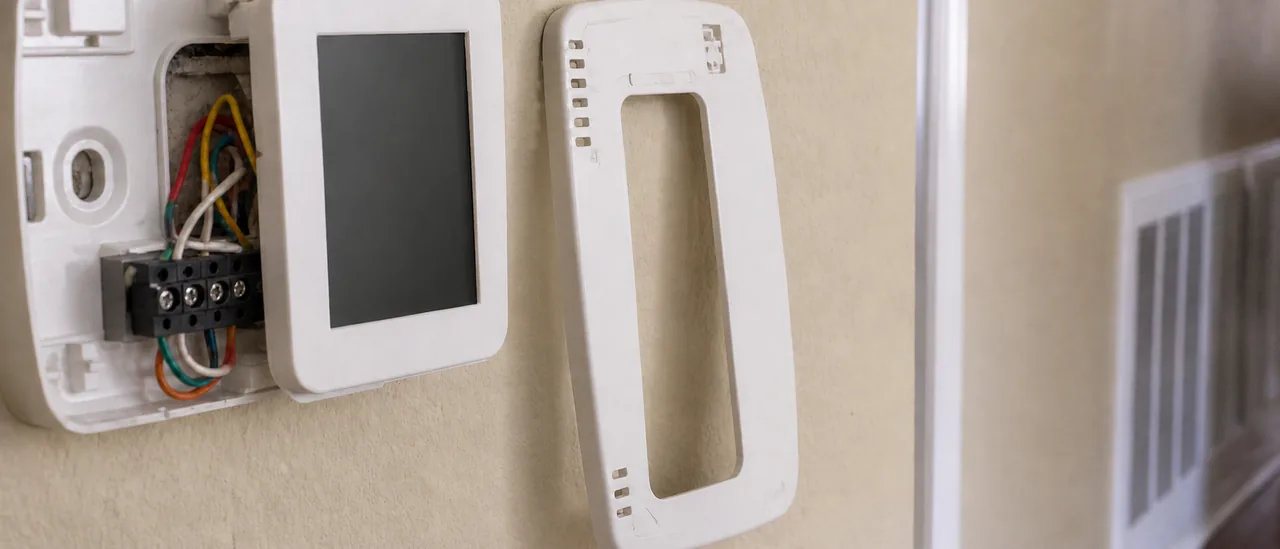
Existing wiring is often the dividing line between a routine swap and a more involved job. Many smart controls need consistent power through a common wire, while some systems require an adapter. Line-voltage wiring, multi-stage equipment, variable-speed systems, and zoned systems can also narrow the compatible choices or require specialist installation.
Access affects labor as well. A usable cable at an open wall location is simpler than fishing new wire, repairing finishes, relocating the control, or tracing an intermittent fault. Urban labor rates, travel distance, after-hours service, taxes, and local permit rules can further move a quote away from a national estimate.
Keep the scope narrow
A thermostat-only estimate does not cover a failed transformer, control board, zone panel, furnace, heat pump, or air conditioner. If testing points elsewhere, ask for a separate diagnosis and itemized price before comparing the bill with thermostat benchmarks.
When to obtain a specialist estimate
Get an HVAC or electrical evaluation when the diagnosis is uncertain, the wiring is line voltage, or the home has zoned, multi-stage, or variable-speed equipment. ENERGY STAR specifically notes that system type and wiring affect compatibility and that complex systems may warrant professional installation.
For budgeting, compare written estimates on the same scope. Each should say whether diagnosis, equipment, wiring changes, finish repair, testing, tax, and permit costs are included. That makes a low quote and a high quote meaningfully comparable—and prevents a thermostat-sized problem from producing an HVAC-sized surprise.