On this page
The short cost answer
As of August 2026, a practical U.S. budget is $100 to $600 to correct one or several improper double-tapped branch breakers. That generally includes the service call, evaluation, small connection materials, and any ordinary replacement breakers. The correction method, number of affected circuits, and available panel capacity change the price most.
A simple correction often stays near $100 to $200, largely because electricians commonly charge a call-out minimum. Adding or replacing breakers can move the total toward $150 to $600. A subpanel or full panel replacement is a separate project, not the normal price of fixing one double tap.
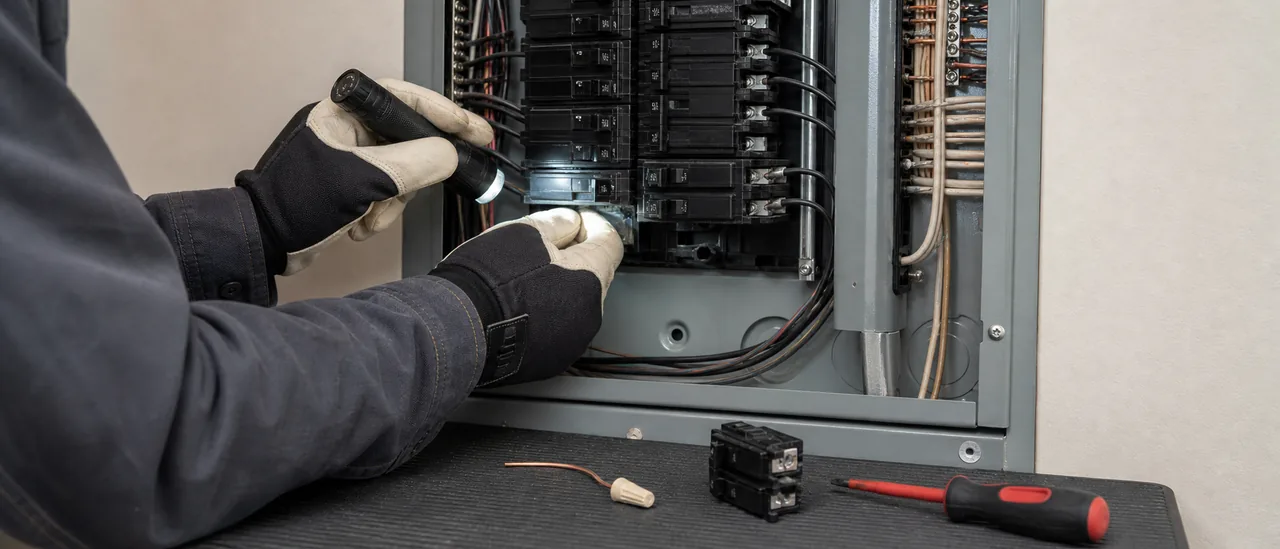
“Double-tapped” means two conductors terminate at one breaker connection intended for only one. It is not automatically a defect whenever two wires are visible. The breaker’s labeling, conductor material and size, and exact terminal design determine whether two conductors are permitted.
What the price includes
The electrician must first confirm that the inspection finding is actually improper. That requires identifying the breaker and checking how many conductors its terminal accepts. For example, current manufacturer guidance says certain 10- to 30-amp breakers accept two copper conductors of specified sizes, while several related breaker types do not.
When correction is needed, the scope may include tracing the affected circuits, changing connections or suitable breakers, or adding approved circuit capacity. The quote should also identify testing, permit fees, and any repair to heat-damaged wiring or terminals.
| Scenario | Planning range | Likely scope |
|---|---|---|
| Low | $100–$200 | One straightforward connection correction during the minimum service call |
| Typical | $150–$600 | Diagnosis plus one or more standard or specialty breaker changes |
| High | $500–$1,700+ | A subpanel is needed because suitable breaker space is unavailable |
These are planning figures, not fixed prices. One current market guide places standard single-pole breaker replacement at $100 to $180, a new breaker at $150 to $300, and total breaker-replacement work at $100 to $600. It lists an installed subpanel at $500 to $1,700.
The main cost drivers
The least complicated valid correction costs less. Small connection materials may cost little, but the visit minimum can still control the invoice. A new breaker adds part cost and must be suitable for both the panel and circuit.
Several findings require more diagnosis. The electrician may need to trace circuits, confirm conductor sizes, and determine whether the breaker terminal is marked for two conductors. Older or hard-to-find breakers and special protection functions can add cost.
Panel capacity creates the largest jump. If there is no approved breaker position, the electrician may propose a compatible space-saving configuration or a subpanel. A complete panel replacement, currently estimated at $850 to $4,000, should have a separate justification and scope; the double tap alone does not establish that it is necessary.
Location changes the total. Labor rates, travel, electrician minimums, permit rules, and inspection requirements vary by market. Current pricing guidance lists $50 to $130 per labor hour plus a $100 to $200 call-out fee, with many providers using a one- or two-hour minimum.
Treat heat or arcing evidence as a different scope
Discoloration, melted insulation, a burning odor, or a damaged terminal can require more than rearranging conductors. Avoid opening the panel or disturbing the connection; have a qualified electrician evaluate the affected breaker, wiring, and panel connection.
When to obtain a specialist estimate
An on-site electrician’s estimate is appropriate when the breaker labeling is unclear, several circuits are involved, the panel is full, or the inspection notes heat damage. Ask for separate prices for the smallest acceptable correction, added breaker or subpanel work, and any proposed full panel replacement. That separation makes the estimate—and its limitations—much easier to evaluate.