On this page
Typical crawl-space duct repair cost in 2026
As of August 2026, plan on $200 to $900 for a typical 30-foot professional crawl-space duct repair. That range can include labor and ordinary materials for sealing, supporting, or patching accessible ducts. The repair type, crawl-space access, and amount and material of ductwork usually move the price most.
A small hole may cost $150 to $350 to repair. A 30-foot sheet-metal repair can reach $250 to $1,000, while multi-section replacement may fall outside these repair ranges. These are national estimates, not a quote for a specific house.
Cost by repair scenario
| Scenario | 2026 planning range | Main price influence |
|---|---|---|
| Low: one repairable hole | $150–$350 | Limited patching and labor |
| Typical: 30-foot crawl-space repair | $200–$900 | Repair scope and access difficulty |
| High: 30-foot sheet-metal repair | $250–$1,000 | Material and repair complexity |
The ranges overlap because “duct repair” describes several different jobs. Fixr's broader national estimate is $200 to $1,000, with $600 reported as the common price for repairing and sealing a leaky section. A useful budget therefore starts with the observed defect, not a single average.
What the price includes
A written estimate should identify the affected supply or return duct, repair method, materials, labor, and post-repair check. It should also say whether the contractor will replace wet or damaged insulation, add supports, remove discarded material, or test airflow after the work.
Do not assume the price includes crawl-space moisture correction, pest removal, microbial remediation, asbestos work, excavation, permits, or repairs to floors and walls. Those are separate scopes and may require different qualified specialists.
Compare the same scope
Ask each estimator to separate sealing, section replacement, insulation, supports, testing, and unrelated crawl-space work. Similar totals can cover very different repairs.
What changes the total
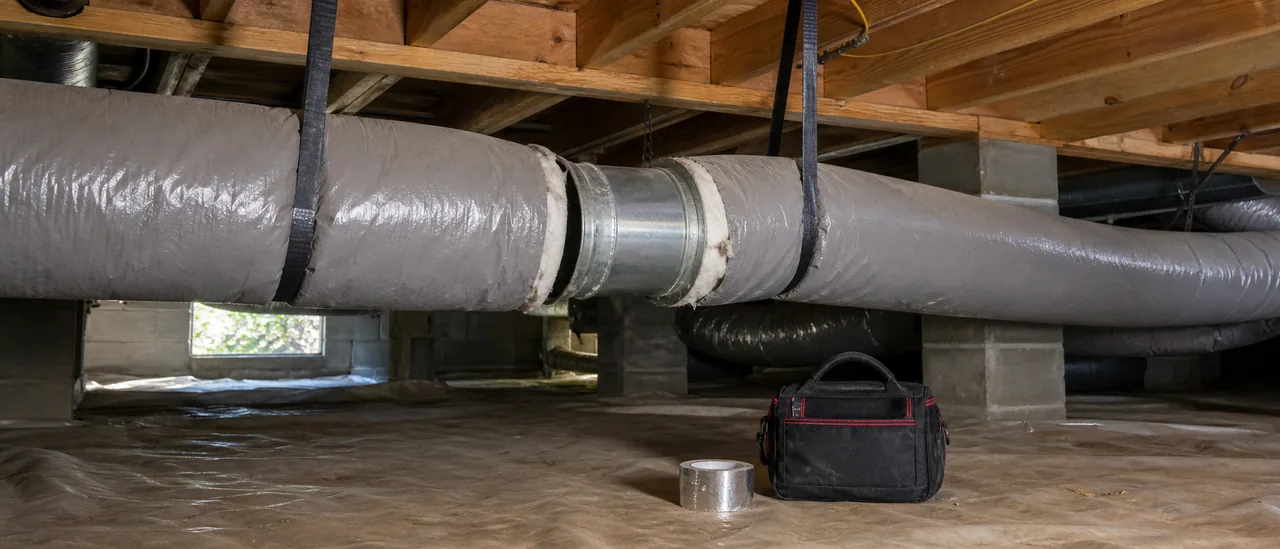
Access and working clearance: A dry, open route to exposed ducts takes less time than a low or obstructed crawl space. A Department of Energy/NREL guide says duct-sealing costs vary tremendously with location, type, duct area, and accessibility, and that labor commonly dominates the job. The ASHI Standard of Practice further illustrates the access limitation: its home-inspection standard does not require entry where vertical clearance is under 24 inches or the opening is smaller than 16 by 24 inches.
Repair extent: Sealing one joint is different from replacing a crushed run, reconnecting several branches, or correcting inadequate supports. More linear feet generally mean more material, fitting, and labor.
Duct material: Flexible duct, duct board, and sheet metal require different repair methods. One national estimate places 30-foot repairs at $200 to $800 for flexible nonmetallic duct and $250 to $1,000 for sheet metal.
Insulation and moisture: ENERGY STAR recommends sealing accessible leaks with mastic or metal tape and insulating ducts in crawl spaces. If insulation is missing or damaged, include that work explicitly. Identify and price the cause of recurring moisture separately rather than treating new insulation as the entire fix.
Region and contractor minimums: Labor rates, travel, demand, and minimum service charges vary by market. A rural trip charge or high-cost metro rate can shift an otherwise identical repair.
When to obtain specialist estimates
Get an HVAC estimate when damage affects multiple runs, airflow remains uneven, ducts are crushed or disconnected, or the repair method is unclear. A home inspection can identify visible concerns, but ASHI describes that inspection as non-exhaustive and excludes concealed conditions; it is not a substitute for duct testing or a repair design.
For meaningful comparisons, request two or three written estimates with the same measured scope. Each should state what will be repaired, what will be replaced, how the finished work will be checked, and which crawl-space conditions are excluded.