On this page
Plan on about $150 to $350 in 2026
As of August 2026, a reasonable budget for a professional gas stove ignition repair is about $150 to $350. That planning range generally covers diagnosis, standard labor, and one common ignition-related repair. The affected ignition system, replacement-part price, and local labor market change the total most.
The range is a benchmark, not a quote. A 2024 U.S. Department of Energy analysis used an assumed repair cost of $153 for a gas cooking top and $350 for a gas oven. Those figures cover cooking-appliance repairs generally, so an actual ignition estimate can fall outside them.
What the price normally includes
Many repair businesses begin with a service call or diagnostic charge. Ask whether that amount is applied to an approved repair, because billing practices differ. A complete estimate should identify the failed component, required parts, labor, and any travel or return-visit charge.
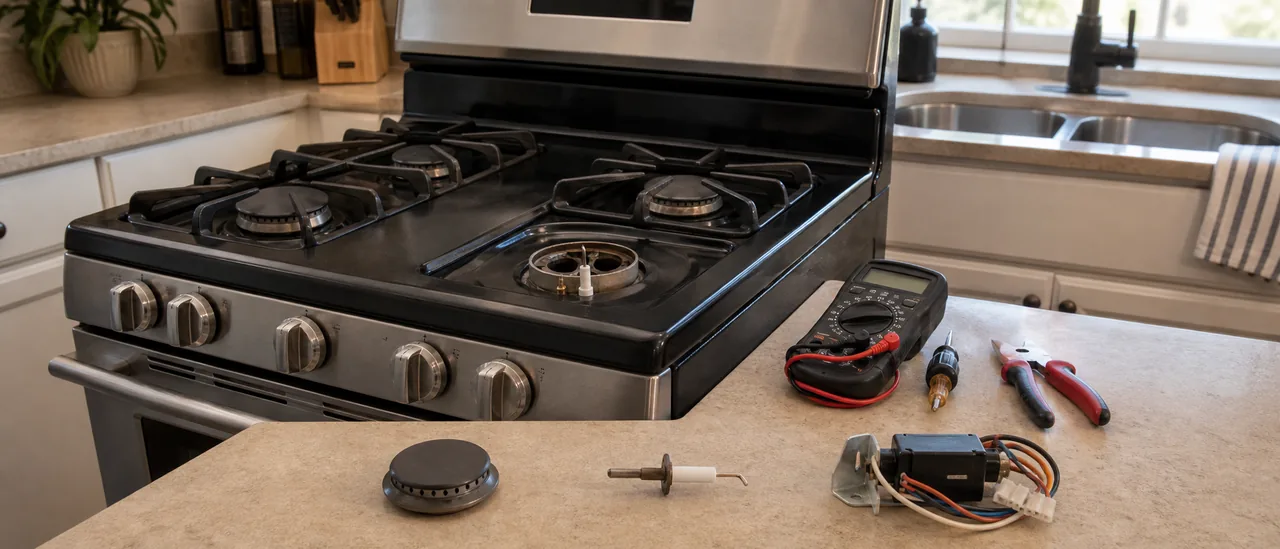
“Ignition problem” can describe different systems. Surface burners commonly use spark electrodes and a spark module. Gas ovens often use a hot-surface igniter that works with a safety valve. Diagnosis matters: cleaning or repositioning a burner component is not priced like replacing an oven igniter, module, wiring, or valve.
| Scenario | Likely scope | Planning cost |
|---|---|---|
| Lower | Diagnosis plus cleaning, adjustment, or a minor accessible fix | Near the service-call minimum to about $150 |
| Typical | One accessible igniter or ignition component, with standard labor | About $150–$350 |
| Higher | Multiple parts, difficult access, specialty components, or added gas/electrical diagnosis | $350 or more |
These are budgeting scenarios, not fixed national rates. Get the scope in writing before authorizing work.
What changes the final estimate
The failed part is usually the largest variable. An individual electrode may be simpler to access than an oven igniter behind panels. A spark module, damaged wiring, or a suspected safety-valve problem can require more diagnosis and higher-cost parts.
Other price drivers include:
- whether the fee covers only diagnosis or also the completed repair;
- part availability and whether a second visit is necessary;
- built-in installation, tight clearances, or cabinetry that limits access;
- after-hours scheduling, long travel distance, or minimum labor charges; and
- local licensing rules when work extends beyond the appliance to a gas connection.
Regional labor differences can be meaningful. The Bureau of Labor Statistics’ May 2023 data showed mean home-appliance-repairer wages varying among states and metropolitan areas. Customer rates also include business overhead, travel, and parts, so wage figures are not the same as a technician’s hourly charge.
A gas odor changes the priority
Do not treat a persistent rotten-egg gas odor as a routine repair estimate. Federal pipeline-safety guidance says to avoid flames and electrical switches, leave the area, and call 911 from a safe location; notify the gas utility as directed locally.
When to request a specialist estimate
Obtain a qualified appliance technician’s diagnosis when cleaning and correctly seating removable burner caps does not restore normal ignition, the clicking continues, or the oven lights slowly. Request an itemized estimate that states whether the diagnostic fee is credited, which component is being replaced, and whether labor and parts carry any warranty.
If the technician suspects the shutoff valve, flexible connector, house piping, or electrical supply rather than the stove’s ignition components, the work may require a separately qualified gas or electrical professional. That expanded scope can move the total beyond the typical appliance-repair range.