On this page
The short cost answer
As of August 2026, fixing mismatched breakers usually starts around $100 to $200 for one straightforward branch-breaker replacement. A reasonable planning range is $100 to $500 when diagnosis, more than one breaker, or a costlier breaker type is involved. The number and type of breakers, local service-call rates, and the panel’s condition move the price most.
That range assumes the panel itself is serviceable and an approved replacement is available. It does not cover a full panel replacement. Current market guides place that much larger project at roughly $850 to $2,500, with some estimates reaching $4,500 when relocation or service-capacity work is added.
“Mismatched” should mean a breaker is not identified for that panel or specifically classified for use in it—not merely that the name on its handle differs. UL Solutions explains that panelboards must identify acceptable field-installed units and that certain classified breakers can be approved for specific panels.
What the price normally includes
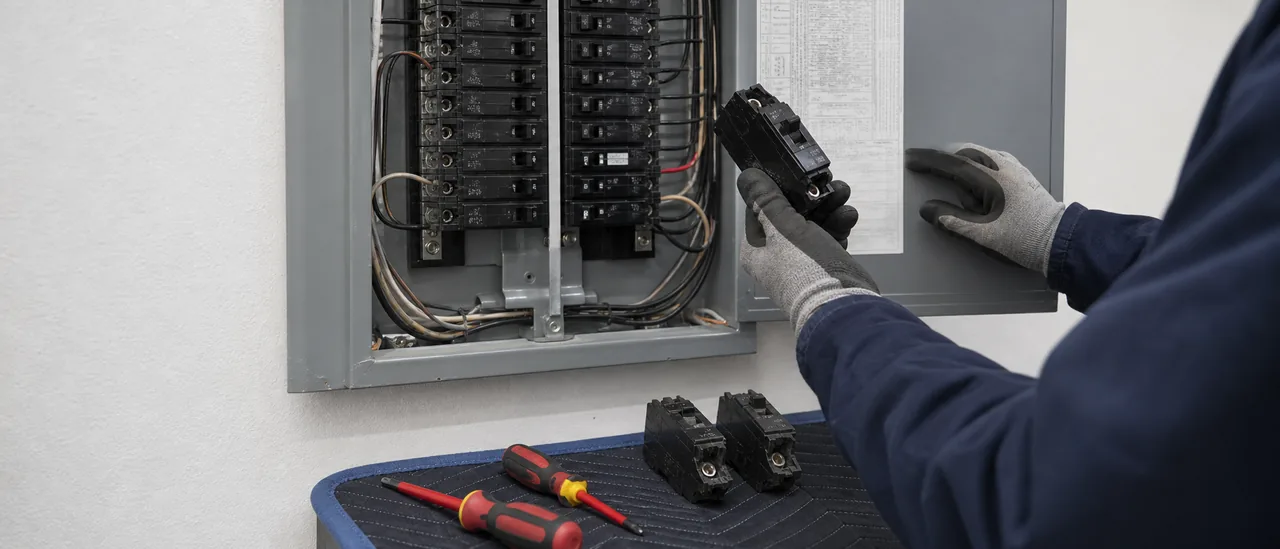
A basic estimate typically covers the electrician’s trip, panel and label review, removal of the incompatible breaker, installation of a suitable replacement, reconnection, and functional checks. The new breaker must match the circuit’s required poles and rating as well as the panel’s approved-unit information.
The breaker itself may be a small share of the bill. One 2026 pricing survey lists a circuit-breaker switch replacement at $100 to $200, while another notes that a small electrical job can still absorb a service-call fee before much labor begins.
| Scenario | Planning range | What changes the estimate |
|---|---|---|
| Low | $100–$200 | One readily available standard branch breaker; sound panel; no permit or repair complications |
| Typical | $200–$500 | Several breakers, added diagnostic time, or specialty protection requirements |
| High | $850–$2,500+ | Panel replacement becomes necessary; service, wiring, location, and permit scope may expand |
These are budgeting ranges, not a quote. A low scenario can cost more in a high-labor market, while replacing several breakers during one visit may reduce the effective cost per breaker.
The main cost drivers
Compatibility verification comes first. The electrician may need to read the panel label, identify the panel model, and check a classified-breaker directory. Physical fit alone is not enough: UL notes that plug-in clips, blades, and electrical spacing depend on proper mating.
Breaker count and function matter. Replacing several ordinary branch breakers takes more material and labor than replacing one. Breakers providing arc-fault or ground-fault protection generally cost more than basic thermal-magnetic units, and a main breaker is a different, more expensive scope.
Panel condition can change the job. Corrosion, heat damage, damaged bus connections, obsolete equipment, or unavailable approved replacements may prevent a simple swap. Those findings do not automatically require replacement, but they justify a separate written scope and price.
Location and permits vary. Electrician minimums, travel, labor rates, access, and local permit or inspection rules all affect the total. Ask whether the estimate includes the service call, breakers, permit, testing, and any panel-label research.
Do not price this from breaker color or brand alone
Ask the electrician to identify the panel model, each breaker type, and the listing or classification used to establish compatibility. A different-looking breaker may be approved, while a breaker that snaps into place may still be unsuitable.
When to obtain a specialist estimate
Request an on-site estimate from a qualified electrician when the panel label is missing, the approved replacement is unclear, multiple mismatches exist, or there are signs of overheating or damaged connections. The estimate should separate a breaker-only correction from any recommended panel, wiring, or service work so the cost difference is understandable.