On this page
The 2026 cost range
In 2026, budget $70–$150 per missing location for typical professional smoke-alarm installation. A simple battery-powered installation may be about $44, while adding hardwired power where no cable exists can reach $500 or more for one location. Alarm count, power source, and access to the mounting point change the price most.
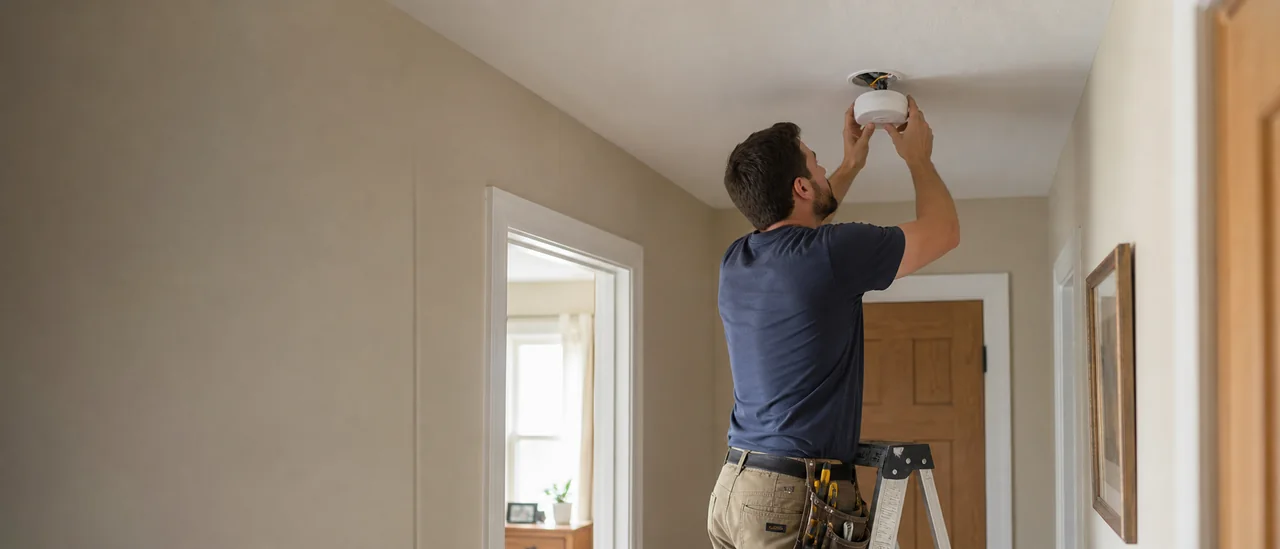
Here, “fixing” a missing smoke detector means installing and testing an appropriate alarm at an uncovered location. Homeowners commonly say “smoke detector,” although the complete residential device that senses smoke and sounds a warning is generally called a smoke alarm.
These are national planning figures, not a quote. The $70–$150 range represents a normal installed unit; it should not be multiplied blindly when a home needs several alarms or new wiring.
What the price includes
A straightforward estimate normally combines the alarm, mounting hardware, installation labor, and a functional test. Confirm those items in writing, particularly if the quote lists labor and equipment separately.
Battery-powered work is usually limited to selecting the correct location, fastening the mounting plate, attaching the alarm, and testing it. Hardwired work can require an electrical box, cable, circuit and interconnect connections, a backup power provision, and electrical testing. Ceiling repair and painting may remain outside the electrician’s scope.
| Planning scenario | Approximate 2026 cost | What changes the scope |
|---|---|---|
| Low | About $44 for one location | Battery-powered alarm; easy mounting access |
| Typical | $70–$150 per location | Professional installation with ordinary access |
| High | $500+ for one location | New hardwiring, cable routing, or difficult access |
A separate 2025 estimate placed three hardwired alarms with new bases at up to $398. That example shows why a multi-alarm total may not equal the single-unit rate times the quantity: one visit can spread setup time across several locations.
What drives the total
How many alarms are actually missing. The U.S. Consumer Product Safety Commission advises working smoke alarms on every level, inside bedrooms, and outside sleeping areas. A qualified evaluation or local requirements may identify more locations than a quick room count.
Battery-powered or hardwired installation. A mounting-only job avoids cable work. Reusing a sound electrical box and suitable existing wiring is generally less involved than opening finished surfaces and routing a new cable.
Ceiling access and repairs. High, sloped, masonry, or finished ceilings can require additional equipment and labor. Attic access may simplify cable routing; insulation, blocked cavities, or multiple finished floors may complicate it.
Electrical and interconnection scope. A quote rises when it includes new boxes, circuit work, interconnection with other alarms, troubleshooting, or correction of damaged wiring. If wiring is involved, the electrician’s published labor component is commonly $50–$100 per hour, before regional differences and job minimums.
Local rules and labor market. Required alarm locations, power arrangements, permits, and who may perform the work vary by jurisdiction. Local wage levels, travel, and minimum service charges also make the same physical job cost more in one market than another.
When a specialist estimate is useful
Get an electrician’s on-site estimate when no wiring is visible at the missing location, several alarms must interconnect, a breaker or damaged conductor is involved, or cable must cross finished rooms. For a mounting-only installation, first confirm that the selected alarm arrangement satisfies local requirements.
Ask each estimator to use the same location count and state whether equipment, wiring, testing, permit assumptions, access equipment, and surface repairs are included. Comparable scopes matter more than the lowest unexplained total.