On this page
The most likely meaning
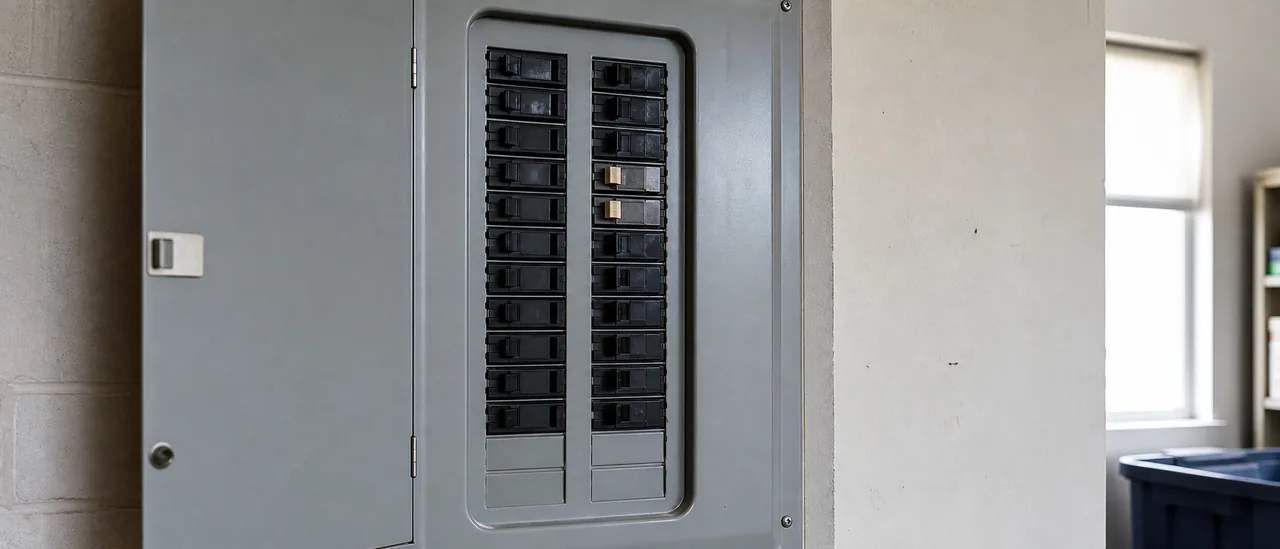
Mismatched breakers usually means that one or more breakers differ in brand, type, size, or appearance from the others in the panel. That difference is a reason to verify compatibility, but it does not prove the installation is defective.
A breaker from another manufacturer may be unsuitable even when it snaps into place. UL Solutions explains that panelboards must identify field-installed units that can be added because breakers from different manufacturers or of different styles are not necessarily interchangeable.
There is an important exception. A third-party-classified replacement breaker may be approved for specific panelboards. The exact breaker and panel combination—not color, handle shape, or physical fit—determines whether that exception applies.
Other reasons breakers may look mismatched
A panel may contain legitimate visual differences after a circuit was added or a breaker was replaced. Two-pole breakers, compact tandem-style breakers, and breakers with arc-fault or ground-fault functions can also look different from ordinary single-pole breakers.
The concern may instead involve the wrong breaker series, an unapproved replacement, or a breaker rating that does not match the protected conductor or intended circuit. A standard inspection can identify visible differences and accessible signs such as heat discoloration, damage, loose seating, or altered labels. Those observations still do not establish the breaker's internal condition.
How compatibility is confirmed
Verification starts with the panelboard label, the breaker's manufacturer and type markings, and any classification documentation supplied for that replacement breaker. UL says classified breakers are suitable only for the specific panelboards identified on the breaker or in the accompanying publication.
An inspector working under the ASHI Standard of Practice inspects panel interiors, conductors, and overcurrent-protection devices. However, that standard does not require measuring amperage, voltage, or impedance. A home inspection therefore reports observable conditions; it is not laboratory testing or a substitute for tracing every circuit and verifying every installation detail.
Do not remove the panel cover yourself
Electrical panel interiors may remain energized even when the main breaker is off. The U.S. Consumer Product Safety Commission advises having a qualified electrician perform work inside a panel.
Urgency and the practical next step
A different-looking breaker without heat damage, arcing evidence, looseness, or repeated tripping is usually a verification item rather than proof of an immediate emergency. Prompt evaluation is more appropriate when the report notes scorching, melted material, buzzing, a burning odor, unstable seating, or an apparently unsupported breaker type.
A qualified electrician can compare the exact catalog and type numbers with the panel label and classified-breaker documentation, then check the connection and circuit rating. Until that evaluation, avoid assuming either that every mixed-brand breaker is unsafe or that physical fit makes it acceptable.