On this page
It means water escaped during or around operation
A dishwasher leak on a home inspection means the inspector observed active water or credible evidence of prior leakage near the appliance. Most often, it points to a sealing, connection, drainage, or installation problem. The finding does not, by itself, identify a failed part or prove extensive damage.
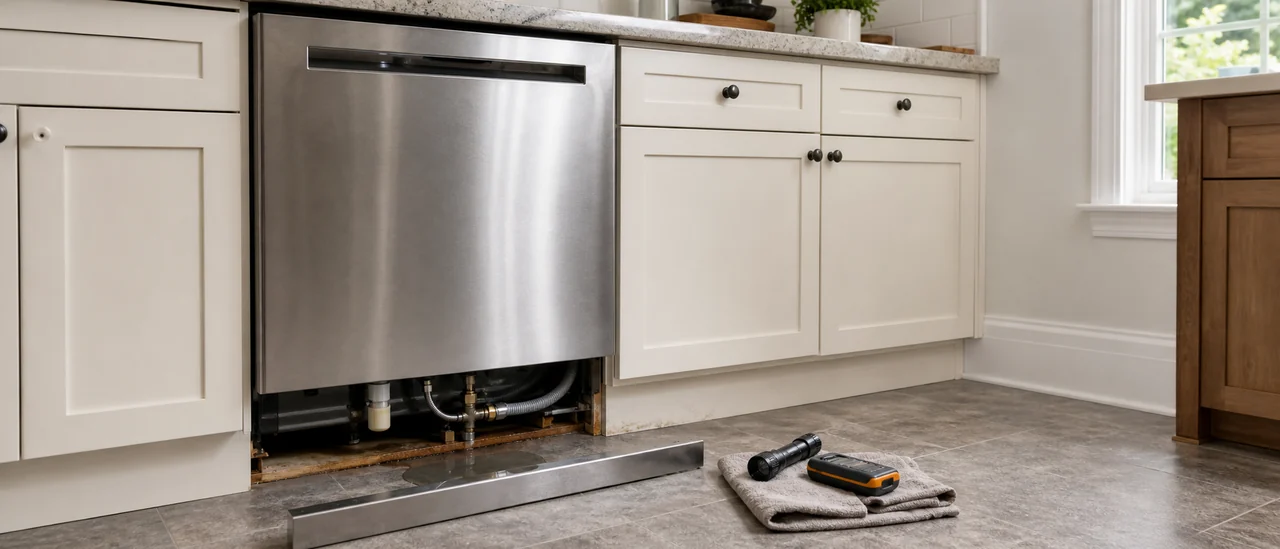
The practical concern depends on where the water appeared, when it appeared, and what nearby materials show. A few drops at the door can have a different cause and consequence than water emerging from beneath the cabinet.
Plausible causes
The visible pattern helps narrow the possibilities:
- At the door: a damaged, warped, or dirty gasket may prevent a proper seal.
- Below or beside the unit: the supply connection, drain hose, or another concealed component may be leaking.
- Near the sink cabinet: the discharge connection or drain arrangement may be involved.
- Only during a cycle: movement, filling, spraying, or draining may trigger a leak that is absent while the appliance sits idle.
These are possibilities, not a diagnosis. Water can travel along flooring, cabinetry, or a hose before becoming visible, so the wet spot may not sit directly below its source.
The report describes a condition, not a complete teardown
A standard inspection is visual and limited to readily accessible components. It does not require dismantling the dishwasher or determining the hidden cause of a deficiency.
What an inspection can confirm
Under the current American Society of Home Inspectors standard, an installed dishwasher is operated with normal controls to activate its primary function. The inspector can report visible leakage, accessible staining or deterioration, when the leak appeared, and any related operating limitation.
The same standard does not require testing every feature, finding concealed conditions, or determining a deficiency’s cause. An appliance that is shut down, inoperable, or unsafe to operate may not be run. Standards and inspection agreements vary, so the report should state what was actually inspected.
Confirmation beyond that initial observation may require repeating a controlled cycle while watching accessible areas, examining connections, or removing a service panel. Those steps should be performed only when safe and within the evaluator’s scope. Dry surfaces during a later check do not necessarily disprove an intermittent leak.
How urgent is it?
An active leak should be addressed promptly and the dishwasher should not be run again until the source is understood. Continued water can affect flooring or cabinetry, while water near energized wiring adds a safety concern.
If the report notes only old staining, ask whether the area was dry and whether damage was visible. A qualified appliance technician or plumber can identify the source and repair scope when the leak is active, concealed, or not explained by an accessible connection. Evaluation of damaged cabinets, flooring, or electrical components may require the relevant trade.