On this page
What “old” usually means in the report
An old air conditioner usually means the equipment has increased repair or replacement risk—not that it has failed. Age is a planning clue. The inspection finding should depend on the system's observed condition and operation, not its birthday alone.
InterNACHI's residential standard makes this distinction explicit: reaching or passing a component's normal useful life is not, by itself, a material defect. Federal purchasing guidance uses an 18-year average residential central-air-conditioner life for cost modeling. That planning assumption does not give a specific unit a guaranteed expiration date.
Age is not remaining-life math
A home inspection cannot predict the unit's failure date. Maintenance history, installation, climate, use, and prior repairs can make two same-age systems perform very differently.
Other conditions that change the meaning
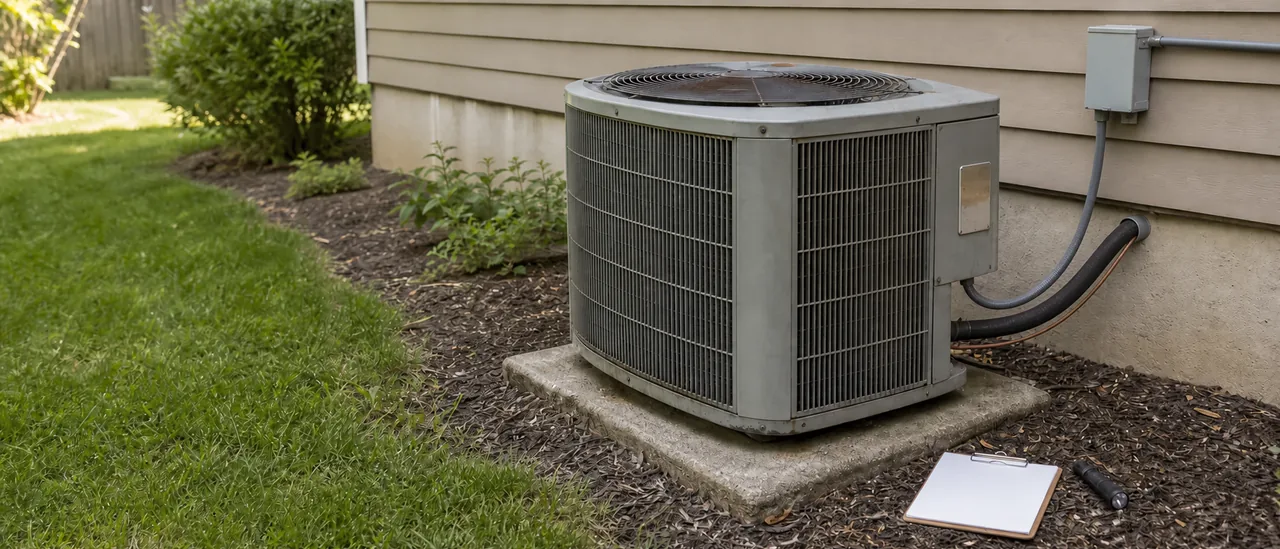
An older system that starts normally and produces cooling may still deserve budget planning. Visible corrosion, damaged insulation, deteriorated wiring, an unstable outdoor unit, water or condensate problems, unusual noise, or failure to operate adds a present condition to the age concern.
Poor cooling does not automatically prove the outdoor unit is worn out. Restricted airflow, duct problems, thermostat issues, improper sizing, or another system fault can produce similar symptoms. A general inspection does not isolate those hidden causes.
What the inspection can confirm
Under the American Society of Home Inspectors standard, the inspector examines central, permanently installed cooling equipment and its distribution system. The process is visual and uses normal operating controls plus readily openable access panels. The inspector may document a data plate, apparent age, physical condition, whether the equipment responds, and notable conditions present during the visit.
The standard does not require determining remaining life, efficiency, cooling adequacy, distribution balance, or the cause of a deficiency. It also excludes window units and other nonpermanently installed equipment. Testing may be omitted when a system is shut down, nonresponsive, unsafe to operate, or vulnerable to damage under current conditions.
Urgency and practical next step
Age alone is not an emergency and does not automatically require replacement. Read the report for the actual observation: “older” carries less urgency than “did not operate,” active water leakage, damaged electrical components, or another safety concern.
If the system operated without a reported defect, plan for maintenance and eventual replacement rather than assuming immediate failure. If operation was limited, cooling was inadequate, or visible defects were reported, a qualified HVAC technician can assess performance and repair options beyond the home inspection's scope. Immediate hazards should be addressed promptly according to the inspector's recommendation.