On this page
Hail usually signals power, judgment, or deliverance
The Bible presents hail as a real and dangerous weather event, then gives it theological meaning within particular stories, poems, and visions. Most often, hail displays God's power over creation. In some passages it brings judgment; in others it helps deliver God's people or underscores how little humans control the natural world.
The clearest example is the seventh plague in Exodus 9. The hail comes after Pharaoh repeatedly refuses to release the Israelites. It destroys exposed crops, trees, animals, and people, while those who heed the warning can bring servants and livestock into shelter. Here, hail is both judgment on oppression and part of Israel's deliverance.
Joshua 10 describes hailstones striking enemy forces during Israel's battle near Gibeon. The passage treats the storm as divine intervention in that specific conflict. It is not presented as a general forecast or a rule for interpreting every storm.
Poetry uses hail to show human limits
Job 38 places hail among mysteries that Job cannot command or fully comprehend. The point is not a lesson in storm physics. It is part of a sweeping reminder that creation exceeds human knowledge and remains under God's authority.
Psalm 148 includes hail among the elements that fulfill God's command. This poetry emphasizes awe, dependence, and divine sovereignty. It broadens the picture: biblical hail is not always tied to one person's wrongdoing.
A modern hail report answers a different question
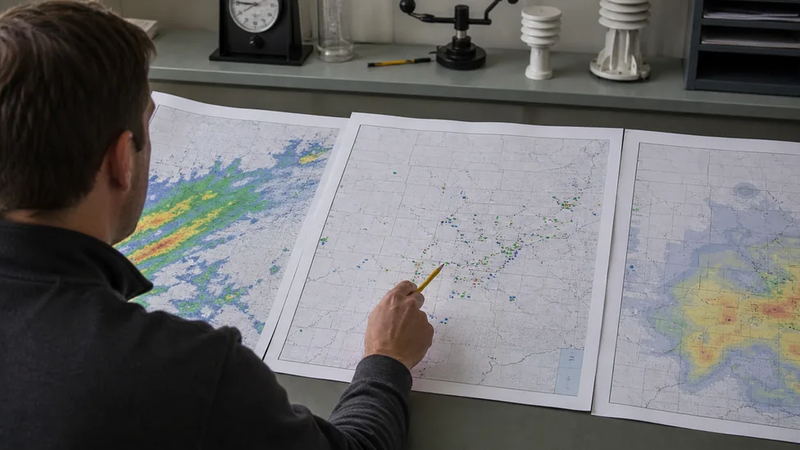
Radar products estimate whether hail may be present. A ground report records hail someone observed. Neither, by itself, confirms damage at a particular property—and none supplies a biblical interpretation of the storm.
Revelation uses hail in symbolic visions
Revelation 8 includes hail in a dramatic trumpet vision that echoes the plagues of Egypt. Its apocalyptic imagery communicates judgment and conflict through a catastrophic scene. Reading that vision as a direct description of an ordinary local hailstorm misses its literary setting.
What these passages do—and do not—mean
Taken together, the passages connect hail with divine power, judgment, deliverance, creation, and humanity's limited perspective. Context determines which theme is active.
They do not offer a biblical basis for declaring that a particular present-day hailstorm punished a specific person or community. The texts identify such meaning inside their own narratives or visions; they do not authorize readers to assign it to every severe-weather event. Physically, hail remains ice falling from a thunderstorm cloud. Spiritually, the Bible uses it to direct attention beyond human control—not to make every weather map a verdict.