On this page
The most common roof-coating problems
Roof coating systems are liquid-applied layers that cure into a protective film over a compatible roof surface. Common problems include poor adhesion, peeling, blisters, cracks, pinholes, uneven thickness, premature wear, and failure where water ponds or details move.
These defects matter because a coating is only the exposed layer of a larger assembly. It cannot correct saturated insulation, loose roofing, failed seams, or inadequate drainage beneath it.
What the defects usually indicate
- Peeling or delamination means the coating has lost its bond to the roof or to another coating layer. Dirt, moisture, incompatible materials, weak existing surfacing, or inadequate preparation may be involved.
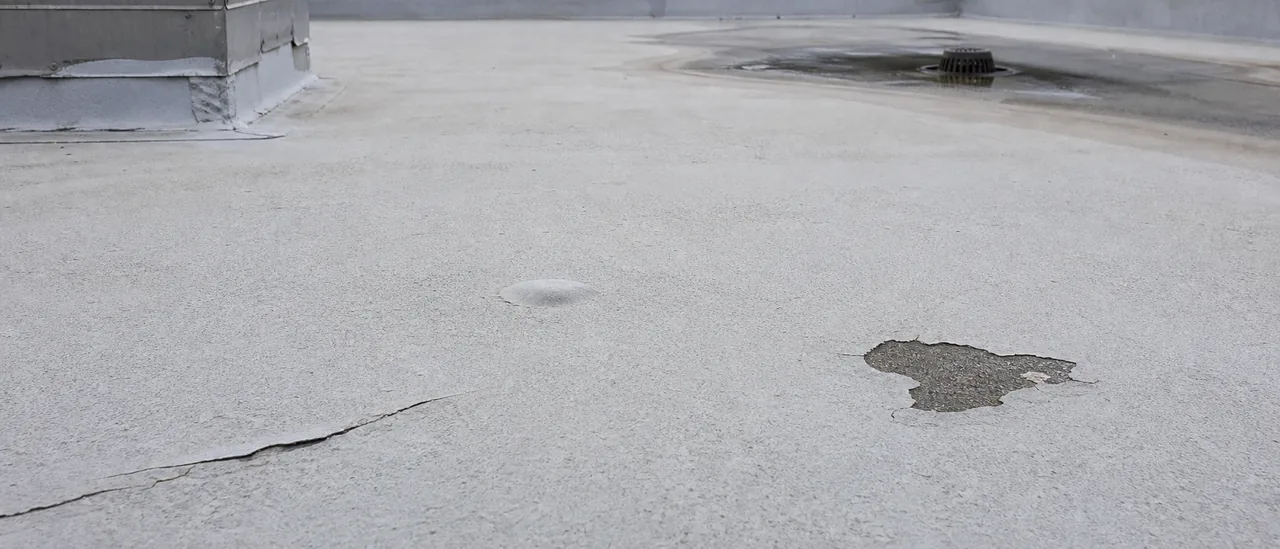
- Blisters and bubbles are raised areas commonly associated with trapped air or moisture and unbonded spaces below the film. Cutting one open without diagnosing the roof can create a direct water entry point.
- Cracks and splits can develop when a thin coating cannot accommodate movement in the roof below. Once open, a crack can admit water beneath the coating and contribute to further separation.
- Pinholes, holidays, and thin spots are gaps or underbuilt areas in the applied film. They often reflect uneven coverage, surface texture, or application that did not achieve the specified dry-film thickness.
- Chalking, erosion, and loss of reflectivity occur as a surface weathers and soils. These signs do not all prove leakage, but they can show that the exposed film is losing uniformity or protective thickness.
Ponding is a condition, not a coating defect
Ponding means water has accumulated in pools on the roof. It can intensify coating deterioration, but applying more coating does not correct the drainage or structural condition that created the low area.
Details and underlying conditions change the answer
Failures often concentrate at seams, drains, penetrations, curbs, fasteners, and transitions. These locations may require repairs, reinforcement, or flashing work beyond a field coat. Movement or an open joint can exceed what an unreinforced coating can bridge.
The coating type also matters. Different formulations have different substrate, primer, thickness, cure, weather, and standing-water limits. A material that performs on one prepared roof may not bond to another. Even adhesion testing has limits: ASTM D3359 notes that failure in a multicoat system can occur between coats, so a tape test may not establish the coating system’s bond to the roof substrate.
Practical bottom line
The visible symptom identifies where to investigate, not the complete cause. A useful assessment checks drainage, moisture, attachment, substrate condition, film thickness, adhesion, and vulnerable details before deciding whether a localized repair or recoating is appropriate. A badly deteriorated, wet, or poorly attached roof is not made sound merely by covering it with a new film.