On this page
Five-inch hail can approach or exceed 100 mph
A 5-inch hailstone can fall at roughly 100 mph (161 km/h) in the lower atmosphere. That is a useful scale, not a universal speed. NOAA’s National Severe Storms Laboratory says hail wider than 4 inches can exceed 100 mph, while natural shape, melting, orientation, and weather conditions create substantial uncertainty.
The five-inch measurement means the stone’s maximum diameter across its widest points. It is larger than the familiar 4.5-inch grapefruit comparison on NSSL’s hail-size list and belongs to the “very large” class discussed in its speed guidance.
Why “about 100 mph” is the honest answer
NOAA publishes a threshold—stones exceeding 4 inches may travel over 100 mph—not one tested speed for every 5-inch stone. Treat 100 mph as an order-of-magnitude estimate for natural hail, not a precision measurement.
What controls the actual speed?
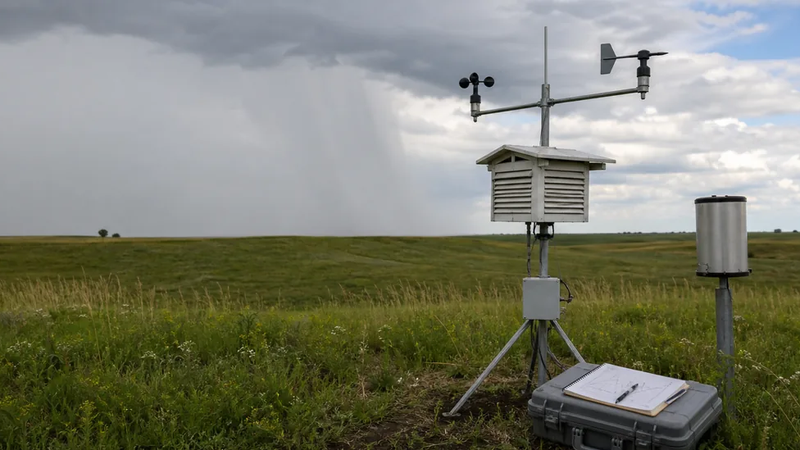
Gravity accelerates a hailstone until drag from the surrounding air largely balances its weight. The resulting terminal velocity describes downward motion relative to the air. It does not automatically equal speed relative to the ground.
Four factors keep the answer variable:
- Shape and orientation: Lobes, rough surfaces, tumbling, and the area facing the airflow change drag.
- Density and melting: Natural hail is not uniformly solid. Melting can shrink or reshape a stone during descent.
- Air density: Thinner air offers less resistance than denser air under otherwise similar conditions.
- Wind: Updrafts and downdrafts alter vertical motion over the ground; horizontal wind adds sideways motion and changes impact angle.
This is why a perfectly spherical ice model can imply more certainty than real hail supports. NSSL notes that natural stones fall more slowly than equivalent solid ice spheres in repeated wind-tunnel research.
Size estimates are not speed or damage measurements
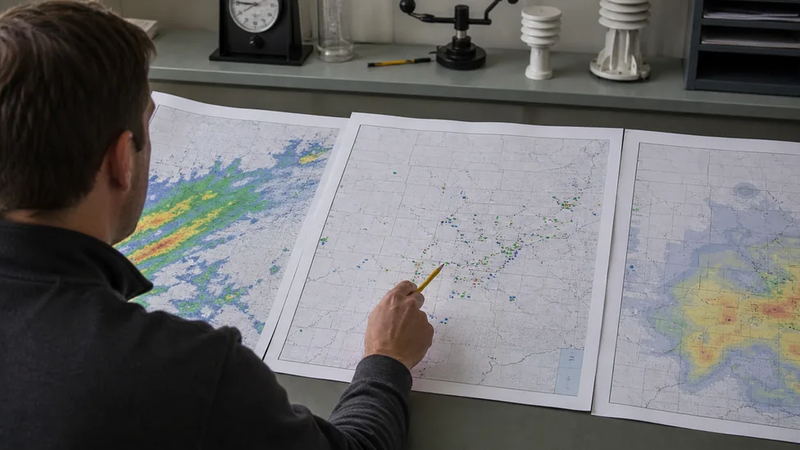
A radar product does not clock an individual hailstone. NOAA’s MESH product estimates the maximum hail size expected from radar and atmospheric inputs, and its published limitations include storm structures that can lead to underestimation.
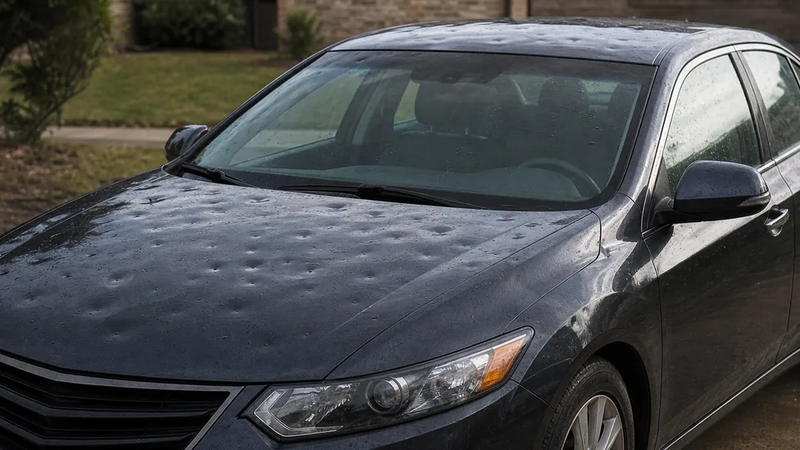
A measured 5-inch stone is a surface observation of size. It still does not establish that the stone was traveling at 100 mph. Likewise, a radar estimate or observed stone does not, by itself, confirm damage at a specific property; that is a separate physical finding.
Bottom line
Use about 100 mph, with speeds over 100 mph possible, as the practical answer for 5-inch hail. The number describes a plausible fall-speed scale. Shape, melting, air density, orientation, and storm winds decide what any individual stone actually does.
Related reading: How Fast Does 2-Inch Hail Fall?